

AI Leadership and Data Strategy Program
- Enterprise AI leadership for the boardroom and beyond
- MIT xPRO faculty perspective on AI strategy and governance
- Data strategy–first approach to scaling AI responsibly
- Agentic AI in enterprise automation and decision‑making
The program learning will pause for holidays during Christmas & New Year (24 Dec 2026 – 1 Jan 2027)
Round Application Deadline
Upcoming application deadline: Invalid liquid data + Applicable taxes
From AI Experimentation to Enterprise-Scale Transformation
Program Overview
It is at this intersection that MIT xPRO’s AI Leadership and Data Strategy is uniquely positioned. Designed as a 20-week executive journey, the program strengthens leadership capability at the convergence of data, enterprise strategy and AI governance, with deliberate contextualization for India’s market realities. Participants learn how to connect AI strategy with data strategy, operating models, and leadership structures, ensuring AI initiatives are embedded into how the organization actually works. This enables cross-functional alignment, clearer ownership, and faster execution at scale. By the end of the program, leaders think less like technology sponsors and more like enterprise stewards of AI. They are equipped to engage boards with confidence, guide senior teams with clarity, and lead organizations through AI-driven change with accountability and authority.
$31 million
98%
Why does this program matter?
MIT xPRO’s AI Leadership and Data Strategy Program addresses this gap by equipping leaders to build structured data strategies and implement responsible AI governance. In a world where competitive advantage is driven by data, it prepares organizations to scale AI confidently, drive innovation, and deliver measurable, enterprise-wide value.
16%
$12.9 million

Key Takeaways

Develop an AI strategy that aligns with organizational goals, drives business value, and enhances competitive advantage

Design data infrastructure that enables effective AI integration, scalability, and responsible data use

Evaluate organizational readiness for AI adoption across leadership, processes, and culture

Apply governance frameworks that ensure transparency, accountability, and ethical management of AI risks, including privacy, bias, and security

Integrate data-driven insights and AI tools into leadership decision making, communication, and performance management

Shape contemporary initiatives that cultivate an adaptive culture of innovation, agility, and sustainable AI transformation
Who is this designed for?
CXOs and senior executives accountable for enterprise-wide AI strategy and deployment, seeking to integrate AI into core business decisions while strengthening their leadership presence in an AI-driven organization.
Mid-level to senior directors and managers driving data-driven innovation, managing cross-functional teams, or guiding organizational adoption of AI-enabled decision systems
Strategy and transformation consultants supporting organizations in designing AI strategies, governance structures, operating models, and enterprise transformation initiatives
Founders, entrepreneurs and business owners who want to develop AI strategy and governance capabilities without requiring technical or coding expertise
Program Highlights

Core curriculum
20 weeks of focused learning on data strategy, leadership, and AI governance

Expert faculty
Gain cutting-edge insights from world-renowned MIT faculty

Strategic frameworks
Access proven frameworks that help you design, deploy, govern, and scale AI responsibly.

Industry-expert masterclasses
Attend workshops on predictive forecasting, API Economy, and Agentic AI in Enterprise Automation

Capstone experiences
Solve real organizational challenges using AI governance and data security

Office Hours with Program Leaders
Attend optional weekly office hours with program leaders to deepen your understanding

Self-Paced Learning
Learn via recorded faculty sessions that provide the flexibility to engage with the program

Curated faculty live sessions
Embark on strategic deep dives with live sessions led by the best minds at MIT
Why MIT xPRO?
Founded in 1861, the Massachusetts Institute of Technology is committed to generating, disseminating, and preserving knowledge and to working with others to bring this knowledge to bear on the world’s great challenges. MIT is ranked #1 in Forbes America's Top Colleges list of the nation’s best schools. MIT is dedicated to providing rigorous academic study, innovative research and scholarship, and a diverse campus community.
MIT’s motto, Mens et manus (“Mind and hand” in Latin), epitomizes the university’s dedication to education focused on practical solutions. Through MIT xPRO — one of the institute's online learning platforms — global executives can access vetted content from world-renowned experts anytime, anywhere. Designed using cutting-edge research in the neuroscience of learning, MIT xPRO programs are application-focused, helping business leaders build their skills on the job and in real time.
What you will learn
Phase 1: Building AI and Data Foundations
Module 1: AI Strategy
Examine AI as a strategic capability. Understand how AI and data reshape business models, differentiate AI types and applications, identify misconceptions that affect strategic decisions, and develop a foundational understanding of what makes an effective AI strategy.
Explain how the evolution of AI and data technologies has reshaped business models and competitive strategy
Differentiate among key types of AI and their applications
Identify common misconceptions about AI that influence strategic decision making
Evaluate how strategic choices shape the effectiveness of an AI strategy
Module 2: Leveraging Data for AI
Understand how big data and AI work together to create organizational value. Analyze data and metadata, and learn why data ownership and accountability are critical for successful AI implementation
Explain how data characteristics and scale influence the way AI systems operate in organizations
Analyze how big data, metadata, and analytics support the development and use of AI
Examine data ownership and shared responsibility as foundations for organizational AI use
Module 3: Data Strategy
Develop a comprehensive data strategy covering data quality, predictive analytics, and decision systems.
Evaluate an organization’s data strategy, including areas for improvement
Explain how data analytics supports strategic and operational decision making
Apply predictive analytics insights to improve decision-making outcomes
Module 4: Deployment and Insights
Examine how organizations deploy AI systems. Explore cost and ROI analysis, scaling models, organizational buy-in, and the conversion of operational data into actionable insights.
Assess the cost implications of deploying an AI and data strategy
Examine key considerations for deploying and scaling an AI and data strategy
Identify data practices that support effective AI deployment and insight generation
Analyze how AI-generated insights improve decision quality, operational efficiency, and strategic alignment
Module 5: Understanding AI Risks
Explore the ethical, operational, and reputational risks of AI, including bias, hidden assumptions, and trust. Examine how these challenges can affect organizational performance and credibility.
Analyze the risks and ethical implications of AI use and its potential impact on organizational trust, reputation, and performance
Apply best practices for the responsible and transparent use of AI across organizational functions
Develop strategies to mitigate operational, ethical, and reputational risks associated with AI adoption
Module 6: Data Privacy
Examine privacy and security challenges associated with data collection. Understand compliance, data rights, and federated AI as risk mitigation approaches.
Examine privacy and security vulnerabilities in data collection
Apply best practices for data protection and compliance based on relevant regional and international data privacy regulations
Analyze how federated and distributed data systems can mitigate data privacy and security risks
Phase 2: Leading AI Transformation
Module 7: AI and Leadership
Discover how AI influences leadership and organizational performance. Explore how AI can enhance your leadership capabilities, including sensemaking, visioning, relating, and inventing, while enabling collaborative human–AI systems.
Analyze the interdependence between effective leadership and AI in driving organizational performance
Examine how AI can enhance key leadership capabilities, including sensemaking, visioning, relating, and inventing
Apply systems thinking to interpret complexity and enable collaborative problem-solving across the organization
Analyze the strategic role of leaders in enabling collaborative human–AI ecosystems
Module 8: Architecting a Nimble Organization
Differentiate between traditional organizational structures and adaptive models designed for complex environments. Explore how strategic autonomy, collective intelligence, and data-driven feedback systems enable organizational agility.
Analyze the differences between traditional command-and-control structures and adaptive cultivate-and-coordinate organizational models
Analyze how strategic autonomy can enable agility and innovation
Evaluate decision-support systems and data-driven feedback mechanisms that enhance organizational adaptability and foresight
Apply strategies for cultivating collective intelligence that strengthen strategic learning and responsive leadership
Module 9: Architecting the Gameboard at the Team Level
Explore how nimble organizations build and lead x-teams to strengthen collaboration and performance. Examine how AI capabilities and human teams can work together through intentionally designed partnerships that enhance agility and decision making.
Analyze the characteristics and leadership behaviors that make x-teams effective in nimble organizations
Develop strategies for building and leading x-teams
Examine how AI capabilities and x-teams reinforce each other to improve collaboration, agility, and performance
Module 10: Developing Your Leadership Signature
Assess your leadership strengths and limitations to define a distinctive leadership signature. Explore concepts such as the Incomplete Leader and social network analysis to strengthen team capability and collaboration.
Assess your leadership capabilities to identify strengths, limitations, and areas for growth
Define your unique leadership signature based on self-assessment and feedback
Identify the leadership and technical capabilities needed to build a high-performing, future-ready team
Apply social network analysis concepts to evaluate team dynamics, communication patterns, and opportunities to strengthen collaboration
Module 11: AI Governance
Examine how organizations design AI governance systems that embed accountability and ethical oversight into processes. Evaluate centralized and distributed governance models, and define the roles, responsibilities, and cultural enablers required for responsible AI at scale.
Design an AI governance policy that embeds accountability into organizational processes
Evaluate centralized and distributed governance models for AI oversight
Define roles and responsibilities required for ethical AI management
Develop strategies for fostering a culture of responsible AI use
Module 12: Culture of Innovation
Explore how organizations cultivate sustainable cultures of innovation in the context of AI trends. Identify barriers to change and develop initiatives that strengthen adaptability, organizational learning, and long-term strategic resilience.
Analyze the opportunities and challenges presented by future AI trends
Examine the organizational value of cultivating a culture of innovation
Develop initiatives that strengthen a culture of innovation
Evaluate barriers to innovation and strategies for reducing resistance to change
Applied playbook activities
Throughout the program, you will work with structured playbook activities designed to translate core concepts into practical organizational action. These playbooks provide step-by-step methods for applying AI strategy, strengthening data governance, developing leadership capabilities, and translating innovation culture into practical organizational action.
Data management in your organization
An AI strategy road map
Responsible AI in your organization
Federated data
AI tools for leadership
Organizational analysis
xTEAMS
Assessing your leadership strengths and weaknesses
Culture strategy
Live sessions by Industry Experts
Predictive Forecasting Using Excel and Tableau
API Economy and Cloud-Native Thinking
Masterclass: Agentic AI in Enterprise Automation
Assessing Organizational Data Readiness for Generative AI
Live online sessions
Pitfalls of AI: The Strategic and Operational Risks of Deepfakes
This session examines the negative aspects of AI. You will explore the mechanics of deepfake fraud, a rapidly evolving new threat to businesses and individuals. Through real-world cases, you will assess its impact on security and reputation and identify the practical strategies for detection and mitigation.
Do not Wait for Perfect, Act with Purpose: Building Strategic Advantage in the Imperfect Generative AI Era
Generative AI is already transforming businesses, not because it is flawless, but because some leaders are building learning velocity while others debate readiness. In a rapidly evolving technology landscape, the ability to experiment, learn, and adapt more quickly than competitors is itself a competitive advantage. We mocked the first iPhone for lacking copy-paste, and then we bought 1 billion of them. The organizations that act now strategically, not perfectly, will define the next era.
Human–AI Collaboration for Innovation: Real-World Insights and Strategy Development
The session explores practical applications and strategic uses of AI, covering technological fundamentals, data quality, and evolution from early expert systems to modern language models. It illustrates how AI enhances individual productivity, group collaboration, and high-level strategic insights through real-world experiments, and outlines emerging trends in cost reduction, deployment, and business transformation.
Surviving and Thriving in the New World of AI
This session explores how leaders can navigate the dual promise and pitfalls of AI by developing new mindsets and practices. The key topics include the strategic importance of continuous sense-making, smart experimentation, distributed decision making, people management in the AI era, and concrete steps for responsible adoption.
Note: The topics are indicative and subject to change based on speaker availability.
Capstone experiences
The program culminates in a series of capstone experiences that challenge you to apply AI strategy, data systems, governance frameworks, and leadership concepts to realistic organizational scenarios. These assignments build progressively across modules, helping you approach AI transformation as a coordinated organizational initiative rather than isolated technology projects.
Genospital's AI strategy
Big data at Genospital
Genospital's data strategy
Implementing Genospital's AI strategy
Overcoming the risks
Preserving data privacy and security
Addressing a leadership challenge
Designing a more adaptable organization
Leveraging AI and xTEAMS
Leadership and team capabilities
Leadership responsibility
Creating your strategic plan
Meet the faculty

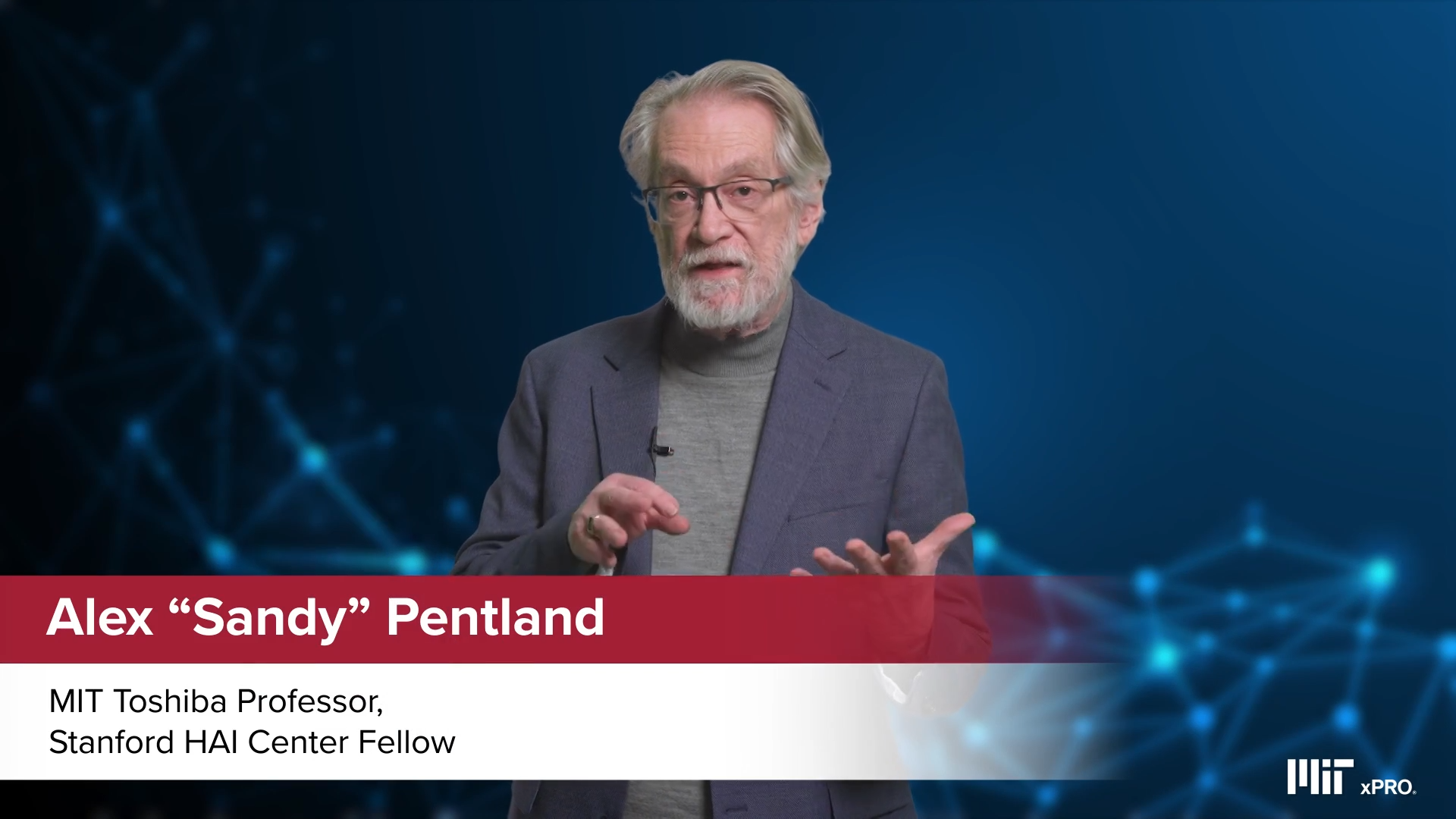
Alex “Sandy” Pentland
Faculty Director, MIT Connection Science Research Initiative; Toshiba Professor of Media Arts and Sciences, Massachusetts Institute of Technology (MIT)
Alex “Sandy” Pentland is the founding faculty director of the MIT Connection Science Research Initiative, which uses network science to understand and influence real-world hum...

Deborah L. Ancona
Seley Distinguished Professor of Management; Professor of Organizational Studies; Founder, MIT Leadership Center, MIT Sloan School of Management
Deborah L. Ancona’s pioneering research on how successful teams operate highlights the importance of managing both outside and inside team boundaries. This work led to the con...
Special Guest Speakers

Matias Alba
Head of Customer Experience and Innovation, EarnIn
Matias Alba is the head of customer experience and innovation at EarnIn, a US-based fintech organization, where he focuses on reimagining customer experience in the age of AI....

Tammy Savage
CEO and Cofounder, Groopit
Tammy Savage focuses on helping leaders use AI to solve complex organizational problems by connecting AI with real-time human intelligence.
Before cofounding Groopit, Savage ...
Program Leader

Milind Naik
Chief Technology Officer
With over 30 years of experience, he has developed deep expertise in establishing scalable engineering processes through the adoption of innovative technologies, while also bu...
Note: The availability of program leader may vary across cohorts. The above profile serves as a representative persona of the program leaders.
Certificate
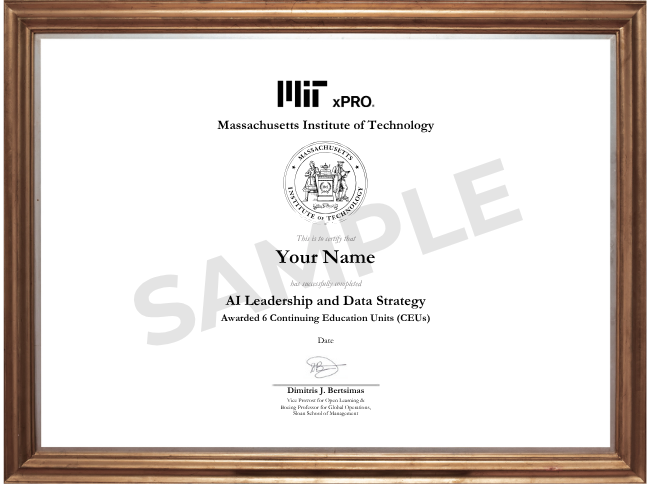
Get recognized! Upon successful completion of this program, MIT xPRO grants a certificate of completion and six Continuing Education Units (CEUs). This program is graded as a pass or fail; participants must receive 75% to pass and obtain the certificate of completion.
After successful completion of the program, your verified digital certificate will be emailed to you, at no additional cost, in the name you used when registering for the program. All certificate images are for illustrative purposes only and may be subject to change at the discretion of MIT.
Registration for this program is done through Emeritus. You can contact us at mit.xpro@emeritus.org
This program is open for enrolments for residents of India, Bangladesh, Bhutan, Myanmar, Nepal, Pakistan, Sri Lanka, Philippines, Indonesia, Thailand, Vietnam and Malaysia only.
Note:
The learning facilitators may change for upcoming batches based on availability and the office hour timings and dates may be changed based on a mutually decided schedule between Emeritus and the Learning facilitator.
*Mentioned timelines are tentative.
FAQs
What is the LAI leadership program from MIT xPRO?
The AI Leadership and Data Strategy Program from MIT xPRO is a 20-week online program designed to help professionals guide enterprise AI adoption and organizational transformation. The curriculum focuses on designing AI strategy, evaluating data readiness, interpreting predictive analytics insights, and developing governance systems that support responsible AI adoption. Through applied frameworks, structured playbook activities, industry case studies, and capstone experiences, this AI leadership program explores how organizations translate AI initiatives into coordinated enterprise decision making rather than isolated experiments.
Who should enroll in this AI leadership program?
The AI Leadership and Data Strategy Program from MIT xPRO is designed for professionals responsible for guiding AI adoption, strategy, and organizational transformation. Participants may include CXOs and senior executives, directors, managers, strategy consultants, and founders who want to better understand how artificial intelligence influences enterprise decision making. The curriculum of this AI leadership program focuses on strategic leadership and organizational capabilities rather than technical implementation.
How is this MIT AI leadership course different from technical AI programs?
MIT xPRO’s AI Leadership and Data Strategy Program focuses on strategy, governance, and leadership rather than coding or machine learning model development. This AI for leaders course examines how organizations design AI strategy, strengthen data systems, and guide responsible AI adoption through frameworks, case discussions, and organizational leadership concepts. The program is led by expert MIT faculty, Alex “Sandy” Pentland and Deborah Ancona, whose research explores data-driven systems, organizational leadership, and innovation in complex environments.
What topics are covered in this artificial intelligence leadership course?
This artificial intelligence leadership course explores how AI, data strategy, and leadership capabilities intersect in modern organizations. Across 12 modules, participants examine topics such as AI strategy, predictive analytics, data governance, AI risks and ethics, organizational design, leadership development, and governance frameworks. The curriculum also incorporates real-world examples that illustrate how organizations approach AI adoption and enterprise transformation. A series of capstone experiences challenges participants to apply concepts to realistic organizational scenarios.
What kind of practical skills can participants gain from this AI for leaders course?
The AI Leadership and Data Strategy Program from MIT xPRO does not require coding or machine learning expertise. This AI leadership training is designed for professionals responsible for strategic decision making and organizational leadership. The curriculum focuses on evaluating AI initiatives, understanding data strategy considerations, and designing governance systems that support responsible AI adoption rather than developing AI models or writing code.
What certificate will I receive after completing this program?
What are the requirements to earn the certificate?
Each leadership course includes an estimated learner effort per week, so you can gauge what will be required before you enroll. This is referenced in the AI Leadership and Data Strategy program brochure, which you can obtain by submitting the short form at the top of this web page. All programs are designed to fit into your working life. This program is scored as a pass or no-pass; participants must complete the required activities to pass and obtain the certificate of completion. Some programs include a final project submission or other assignments to obtain passing status. This information will be noted in the AI Leadership and Data Strategy program brochure. Please email us if you need further clarification on any specific program requirements.
What type of certificate will I receive?
Upon successful completion of the AI Leadership and Data Strategy program, you will receive a smart digital certificate. The smart digital certificate can be shared with friends, family, schools, or potential employers. You can use it on your cover letter, resume, and/or display it on your LinkedIn profile. The digital certificate will be sent approximately two weeks after the program, once grading is complete.
Can I get the hard copy of the certificate after completing this MIT xPRO AI Leadership and Data Strategy program?
No, only verified digital certificates will be issued upon successful completion. This allows you to share your credentials on social platforms such as LinkedIn, Facebook, and Twitter.
Do I receive alumni status after completing this MIT xPRO AI Leadership and Data Strategy program?
No, there is no alumni status granted for this program. In some cases, there are credits that count toward a higher level of certification. This information will be clearly noted in the program brochure.
How long will I have access to the learning materials for this AI leadership program?
You will have access to the online learning platform and all the videos and program materials for 12 months following the program start date. Access to the learning platform is restricted to registered participants per the terms of agreement.
How does the payment and registration process work for this AI Leadership and Data Strategy program?
Can I still register if the registration deadline has passed?
Yes, you can register up until seven days past the published start date of the program without missing any of the core program material or learnings.
What is the AI Leadership and Data Strategy program fee, and what forms of payment do you accept?
The program fee is noted at the top of this program web page and usually referenced in the program brochure as well. Flexible payment options are available (see details below as well as at the top of this program web page next to FEE).
Tuition assistance is available for participants who qualify. Please fill up the short form.
What if I don’t have a credit card? Is there another method of payment accepted?
Yes, you can do the bank remittance in the program currency via wire transfer or debit card. Please contact your program advisor, or email us for details.
I was not able to use the discount code provided. Can you help?
Yes! Please email us with the details of the program you are interested in, and we will assist you.
How can I obtain an invoice for payment?
Please email us your invoicing requirements and the specific program you’re interested in enrolling in.
Is there an option to make flexible payments for this MIT xPRO AI Leadership and Data Strategy program?
Yes, the flexible payment option allows a participant to pay the program fee in installments. This option is made available on the payment page and should be selected before submitting the payment.
Who will be collecting the payment for the MIT xPRO AI Leadership and Data Strategy program?
Emeritus collects all program payments, provides learner enrollment and program support, and manages learning platform services.
What is the refund and cancellation policy for this program?
Refund Policy
Policy Communication:
Emeritus’ Withdrawal, Refund and Deferral policies are communicated to all learners (both existing and prospective) via the Emeritus website and Learning Management System. It is the learner’s responsibility to review, be aware of and adhere to these policies.
Withdrawal for Non-delivery of Course:
Emeritus will notify learners in writing if (a) the course will not commence on the scheduled course commencement date; (b) the course will not be completed by the scheduled course completion date; or (c) the learner does not meet the course entry or matriculation requirement as set by Emeritus or the university. Within three (3) working days of such notice, Emeritus will inform learners in writing of any available alternative study arrangements.
If a learner declines the offered alternative study arrangements, if any, or desires to otherwise withdraw from the course for the reasons stated in paragraph 2 above, the learner shall request a withdrawal from Emeritus within fifteen (15) calendar days. Upon receipt of the withdrawal request and validation of eligibility, Emeritus shall refund the learner 100% of course and miscellaneous fees previously paid by the learner, except that course application fees are non-refundable and non-transferable. Emeritus shall use commercially reasonable efforts to make such refund within seven (7) working days from receipt of the withdrawal request from learner.
Withdrawal for Other Reasons:
If the learner wishes to withdraw from the course or program for any reason other than those stated in paragraph 2 above, the following provisions shall control all withdrawal requests:
Absent a previous approved request for deferral for the course, learners may request a full refund of all course and miscellaneous fees paid, within fourteen (14) days after course commencement. Application fees for courses are non-refundable and non-transferable. Learners who have previously been granted a course deferral are not eligible for a refund for the course. Partial (or pro-rated) refunds are not offered. Emeritus shall use commercially reasonable efforts to make a valid refund within seven (7) working days from receipt of the withdrawal request from learner.
Emeritus reserves the right, in its sole discretion, to dismiss a learner from a course or program at any time and to provide a refund to the learner pursuant to the stated refund policy in paragraph 2 above. Learners who are dismissed from a course or program due to a violation of Emeritus’ Code of Conduct are not entitled to any refund.
How to Submit a Valid Withdrawal Request:
All withdrawal requests must be sent in writing within the timelines specified in paragraphs 2 or 3 above to:
All refunds will be paid directly to the original payer only, unless written and signed instruction is provided by the original payer to pay the refund to an account belonging to a person other than the original payer.
Bank Charges/Transaction Fees:
In the event of an approved refund, Emeritus will refund the course fee collected and will not be liable to refund any foreign transaction fees, processing charges, or any other bank fees.
Flexible payment options available.
Starts On