

AI Strategy and Leadership Program: Driving Data and Organizational Transformation
Reimagine Leadership with AI and Data Strategy
Program Overview: AI Strategy and Leadership Program
The AI Strategy and Leadership Program: Driving Data and Organizational Transformation from MIT xPRO is a 12-week online program designed for leaders and professionals responsible for shaping strategy and guiding AI adoption across their organizations. Artificial intelligence (AI) is rapidly transforming how organizations compete, innovate, and make decisions. Yet many organizations still struggle to move beyond isolated AI experiments to enterprise-scale impact. The challenge is rarely the technology itself. Instead, leaders must address fragmented data systems, unclear governance structures, and traditional operating models that are not designed for AI-driven decision making.
The program equips leaders like you to design AI strategy, evaluate and strengthen organizational data strategy and foundations, and guide responsible AI adoption across your organization. The program emphasizes enterprise decision making, helping you evaluate data readiness, apply predictive analytics insights, and design governance systems that enable AI initiatives to scale responsibly. Across 12 modules, you will explore how AI and data analytics reshape business strategy, leadership practice, and organizational performance. The learning experience includes applied frameworks, industry examples, and strategic assignments that highlight practical applications of AI-driven transformation and help you move beyond isolated AI pilots toward coordinated enterprise adoption.
63%
Only one in three
3.5 times
Learning Outcomes
The AI Strategy and Leadership Program: Driving Data and Organizational Transformation will equip you to:
Develop an AI strategy that aligns with organizational goals, drives business value, and enhances competitive advantage
Design a data strategy that enables effective AI integration, scalability, and responsible data use
Evaluate organizational readiness for AI adoption across leadership, processes, and culture
Apply governance frameworks that ensure transparency, accountability, and ethical management of AI risks, including privacy, bias, and security
Integrate data-driven insights and AI tools into leadership decision making, communication, and performance management
Develop initiatives that cultivate an adaptive culture of innovation, agility, and sustainable AI transformation
Who Is the AI Strategy and Leadership Program For?
The program is designed for professionals responsible for shaping strategy, guiding organizational transformation, and leading AI adoption across their organizations. It is particularly valuable for:
C‑suite executives and senior leaders, including CEOs, COOs, CTOs, chief data officers, and senior executives, who are responsible for enterprise strategy, governance, and large-scale transformation initiatives
Mid-level to senior directors and managers driving data-driven innovation, managing cross-functional teams, or guiding organizational adoption of AI-enabled decision systems
Strategy and transformation consultants supporting organizations in designing AI strategies, governance structures, operating models, and enterprise transformation initiatives
Founders, entrepreneurs, and business owners who want to develop AI strategy and governance capabilities without requiring technical or coding expertise
Note: No coding or technical specialization is required.
Hear from the Faculty


Program Experience


Note: Session topics are subject to change.
What You Will Learn in the AI Strategy and Leadership Program?
The curriculum explores how AI, data strategy, and leadership capabilities work together to enable enterprise-scale AI transformation. Across 12 modules, you will examine how AI technologies and data analytics shape business strategy, decision making, and innovation in rapidly evolving environments shaped by emerging technologies.
Module 1: AI Strategy
Explain how the evolution of AI and data technologies has reshaped business models and competitive strategy
Differentiate among key types of AI and their applications
Identify common misconceptions about AI that influence strategic decision making
Evaluate how strategic choices shape the effectiveness of an AI strategy
Module 2: Leveraging Data for AI
Explain how data characteristics and scale influence the way AI systems operate in organizations
Analyze how big data, metadata, and analytics support the development and use of AI
Examine data ownership and shared responsibility as foundations for organizational AI use
Module 3: Data Strategy
Evaluate an organization’s data strategy, including areas for improvement
Explain how data analytics supports strategic and operational decision making
Apply predictive analytics insights to improve decision-making outcomes
Module 4: Deployment and Insights
Assess the cost implications of deploying an AI and data strategy
Examine key considerations for deploying and scaling an AI and data strategy
Identify data practices that support effective AI deployment and insight generation
Analyze how AI-generated insights improve decision quality, operational efficiency, and strategic alignment
Module 5: Understanding AI Risks
Analyze the risks and ethical implications of AI use and its potential impact on organizational trust, reputation, and performance
Apply best practices for the responsible and transparent use of AI across organizational functions
Develop strategies to mitigate operational, ethical, and reputational risks associated with AI adoption
Module 6: Data Privacy
Examine privacy and security vulnerabilities in data collection
Apply best practices for data protection and compliance based on relevant regional and international data privacy regulations
Analyze how federated and distributed data systems can mitigate data privacy and security risks
Module 7: AI and Leadership
Analyze the interdependence between effective leadership and AI in driving organizational performance
Examine how AI can enhance key leadership capabilities, including sensemaking, visioning, relating, and inventing
Apply systems thinking to interpret complexity and enable collaborative problem-solving across the organization
Analyze the strategic role of leaders in enabling collaborative human–AI ecosystems
Module 8: Architecting a Nimble Organization
Analyze the differences between traditional command-and-control structures and adaptive cultivate-and-coordinate organizational models
Analyze how strategic autonomy can enable agility and innovation
Evaluate decision-support systems and data-driven feedback mechanisms that enhance organizational adaptability and foresight
Apply strategies for cultivating collective intelligence that strengthen strategic learning and responsive leadership
Module 9: Architecting the Gameboard at the Team Level
Analyze the characteristics and leadership behaviors that make x-teams effective in nimble organizations
Develop strategies for building and leading x-teams
Examine how AI capabilities and x-teams reinforce each other to improve collaboration, agility, and performance
Module 10: Developing Your Leadership Signature
Assess your leadership capabilities to identify strengths, limitations, and areas for growth
Define your unique leadership signature based on self-assessment and feedback
Identify the leadership and technical capabilities needed to build a high-performing, future-ready team
Apply social network analysis concepts to evaluate team dynamics, communication patterns, and opportunities to strengthen collaboration
Module 11: AI Governance
Design an AI governance policy that embeds accountability into organizational processes
Evaluate centralized and distributed governance models for AI oversight
Define roles and responsibilities required for ethical AI management
Develop strategies for fostering a culture of responsible AI use
Module 12: Culture of Innovation
Analyze the opportunities and challenges presented by future AI trends
Examine the organizational value of cultivating a culture of innovation
Develop initiatives that strengthen a culture of innovation
Evaluate barriers to innovation and strategies for reducing resistance to change
Live Online Sessions
Pitfalls of AI: The Strategic and Operational Risks of Deepfakes
This session examines the negative aspects of AI. You will explore the mechanics of deepfake fraud, a rapidly evolving new threat to businesses and individuals. Through real-world cases, you will assess its impact on security and reputation and identify the practical strategies for detection and mitigation.
Do not Wait for Perfect, Act with Purpose: Building Strategic Advantage in the Imperfect Generative AI Era
Generative AI is already transforming businesses, not because it is flawless, but because some leaders are building learning velocity while others debate readiness. In a rapidly evolving technology landscape, the ability to experiment, learn, and adapt more quickly than competitors is itself a competitive advantage. We mocked the first iPhone for lacking copy-paste, and then we bought 1 billion of them. The organizations that act now strategically, not perfectly, will define the next era.
Human–AI Collaboration for Innovation: Real-World Insights and Strategy Development
The session explores practical applications and strategic uses of AI, covering technological fundamentals, data quality, and evolution from early expert systems to modern language models. It illustrates how AI enhances individual productivity, group collaboration, and high-level strategic insights through real-world experiments, and outlines emerging trends in cost reduction, deployment, and business transformation.
Surviving and Thriving in the New World of AI
This session explores how leaders can navigate the dual promise and pitfalls of AI by developing new mindsets and practices. The key topics include the strategic importance of continuous sense-making, smart experimentation, distributed decision making, people management in the AI era, and concrete steps for responsible adoption.
Note: The topics are indicative and subject to change based on speaker availability.
Why MIT xPRO?
The Massachusetts Institute of Technology (MIT) is recognized globally as a leader in technology, AI, and innovation, driving industry transformation through groundbreaking research and real-world application. Founded in 1861 and ranked #1 in Forbes America’s Top Colleges list, MIT has built a legacy of excellence in academic rigor, pioneering discoveries, and cross-disciplinary collaboration. MIT xPRO brings this expertise to professionals worldwide, offering executive-level programs that translate cutting-edge research into practical frameworks for leadership, innovation, and impact in a technology-driven world.
Applied Strategy Playbook
Throughout the program, you will work through structured playbook activities that provide step-by-step guidance for applying AI strategy, strengthening data governance, developing leadership capabilities, and translating an innovation culture into practical organizational action.
Data management in your organization
An AI strategy road map
Responsible AI in your organization
Federated data
AI tools for leadership
Organizational analysis
X-teams
Assessing your leadership strengths and weaknesses
Culture strategy
Capstone Experiences
The program culminates in a series of capstone experiences that challenge you to apply AI strategy, data systems, governance frameworks, and leadership concepts to realistic organizational scenarios. These assignments help you approach AI transformation as a coordinated organizational initiative rather than isolated technology projects.
Addressing a leadership challenge
Designing a more adaptable organization
Leveraging AI and x-teams
Leadership and team capabilities
Leadership responsibility
Creating your strategic plan
Industry Examples


Meet the Faculty
Faculty Director, MIT Connection Science Research Initiative; Toshiba Professor of Media Arts and Sciences, Massachusetts Institute of Technology (MIT); Center Fellow, Stanford Institute for Human-Centered Artificial Intelligence
Professor Alex “Sandy” Pentland has helped create and direct the MIT Media Lab and Media Lab Asia in India. He is one of the most cited computational scientists in the world, ...
Seley Distinguished Professor of Management; Professor of Organizational Studies; Founder, MIT Leadership Center, MIT Sloan School of Management
Deborah L. Ancona’s pioneering research on how successful teams operate highlights the importance of managing both outside and inside team boundaries. This work led to the con...
Guest Speakers

Head of Customer Experience and Innovation, EarnIn

CEO and Cofounder, Groopit

Senior Lecturer, MIT Sloan School of Management

Professor of Organizations, Heinz College of Public Policy and Management and Tepper School of Business, Carnegie Mellon University
Note: Featured guest speakers are subject to change.
Certificate
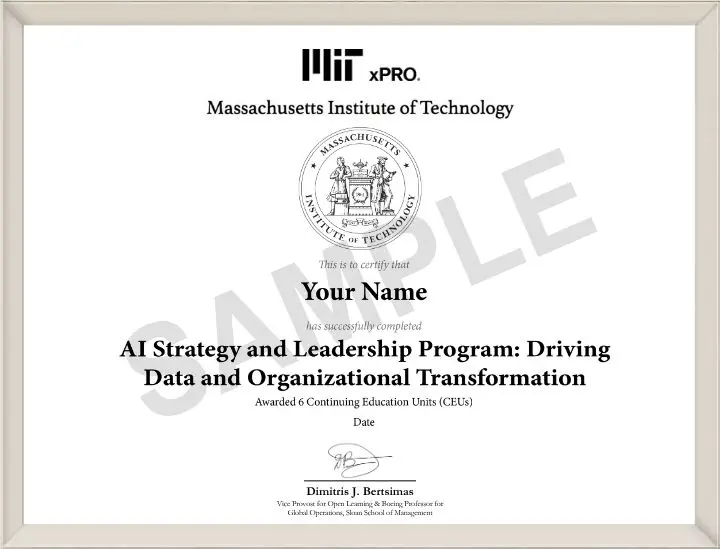
Get recognized! Upon successful completion of this program, MIT xPRO grants a certificate of completion and 6.0 Continuing Education Units (CEUs). This program is graded as a pass or fail; participants must receive 75% to pass and obtain the certificate of completion.
After successful completion of the program, your verified digital certificate will be emailed to you, at no additional cost, in the name you used when registering for the program. All certificate images are for illustrative purposes only and may be subject to change at the discretion of MIT.
Note:
After the successful completion of the program, a verified digital certificate will be emailed to participants, at no additional cost, with the name used when registering for the program.
All certificate images are for illustrative purposes only and may be subject to change at the discretion of MIT xPRO.
Receive an executive certificate with this learning journey
FAQ
The AI Strategy and Leadership Program: Driving Data and Organizational Transformation from MIT xPRO is a 12-week online program designed to help professionals guide enterprise AI adoption and organizational transformation. The curriculum focuses on designing AI strategy, evaluating data readiness, interpreting predictive analytics insights, and developing governance systems that support responsible AI adoption. Through applied frameworks, structured playbook activities, industry case studies, and capstone experience, this AI leadership program explores how organizations translate AI initiatives into coordinated enterprise decision making rather than isolated experiments.
The AI Strategy and Leadership Program: Driving Data and Organizational Transformation from MIT xPRO is designed for professionals responsible for guiding AI adoption, strategy, and organizational transformation. Participants may include senior executives, directors, managers, data and analytics leaders, strategy consultants, and founders who want to better understand how artificial intelligence influences enterprise decision making. The curriculum of this AI leadership program focuses on strategic leadership and organizational capabilities rather than technical implementation.
MIT xPRO’s AI Strategy and Leadership Program: Driving Data and Organizational Transformation focuses on strategy, governance, and leadership rather than coding or machine learning model development. This AI for leaders course examines how organizations design AI strategy, strengthen data systems, and guide responsible AI adoption through frameworks, case discussions, and organizational leadership concepts. The program is led by expert MIT faculty, Alex “Sandy” Pentland and Deborah Ancona, whose research explores data-driven systems, organizational leadership, and innovation in complex environments.
This artificial intelligence leadership course explores how AI, data strategy, and leadership capabilities intersect in modern organizations. Across 12 modules, participants examine topics such as AI strategy, predictive analytics, data governance, AI risks and ethics, organizational design, leadership development, and governance frameworks. The curriculum also incorporates real-world examples that illustrate how organizations approach AI adoption and enterprise transformation. A capstone experience challenges participants to apply concepts to realistic organizational scenarios.
In this AI Strategy and Leadership Program from MIT xPRO, participants explore frameworks and decision-making approaches used to guide enterprise AI initiatives. Through applied assignments, case studies, and a capstone experience, the program emphasizes the development of practical skills, including evaluating data readiness, designing governance systems, interpreting predictive analytics insights, and applying leadership frameworks to guide responsible AI adoption within organizations.
The AI Strategy and Leadership Program: Driving Data and Organizational Transformation from MIT xPRO does not require coding or machine learning expertise. This AI leadership training is designed for professionals responsible for strategic decision making and organizational leadership. The curriculum focuses on evaluating AI initiatives, understanding data strategy considerations, and designing governance systems that support responsible AI adoption rather than developing AI models or writing code.
Whether an AI leadership program is worth pursuing depends on your professional responsibilities and learning goals. For professionals responsible for guiding AI initiatives, strategy, or organizational transformation, structured learning can help clarify how artificial intelligence influences business strategy, data systems, and governance. The AI Strategy and Leadership Program: Driving Data and Organizational Transformation from MIT xPRO examines how leaders design an effective AI strategy, evaluate data readiness, and guide responsible AI adoption through applied frameworks and real-world examples.
How do I know whether this program is right for me?
After reviewing the information on the program landing page, we recommend you submit the short form above to gain access to the program brochure, which includes more in-depth information. If you still have questions on whether this program is a good fit for you, please email learner.success@emeritus.org, and a dedicated program advisor will follow up with you very shortly.
Are there any prerequisites for this program?
Some programs do have prerequisites, particularly the more technical ones. This information will be noted on the program landing page and in the program brochure. If you are uncertain about program prerequisites and your capabilities, please email us at learner.success@emeritus.org for assistance.
What are the requirements to earn a certificate?
This is a graded program. You must complete a combination of individual assignments, quizzes, and a final project. Each component carries a certain number of points, and a cumulative score of 75 percent is required to pass and obtain your professional certificate.
Will I be guaranteed a job upon completion of the program?
The primary objective of this program is to give you the skills you need to be prepared for a job in this field. While eligible participants will receive career coaching and support and may receive introductions to our hiring partners, job placement is not guaranteed.
How much time will I be expected to devote to this program?
Each program includes an estimated learner effort per week. This is referenced at the top of the program landing page under the “Duration” section and in the program brochure, which you can obtain by submitting the short form at the top of this web page.
How will I spend my time in this program?
You will divide your learning time between viewing recorded coding demos, and video lectures, contributing to class discussions, completing assignments, projects, and knowledge checks, and attending optional live sessions with industry experts and program leaders.
How is the program administered? Can the program be accessed any time?
The program is accessed through the custom learning portal. This portal will give you access to all program-related content such as video lectures, assignments, and discussions. Live office hours will be conducted using a webinar tool. The video lectures and assignments are accessible weekly throughout the program. In the event you miss a live session, a recording will be made available.
Do I need to attend live sessions every week?
Faculty video lectures are recorded, allowing you to watch these on your own schedule. However, participation in optional live sessions and discussion boards is highly encouraged. Live sessions will give you the opportunity to draw on the coding experience of our industry-experienced program leaders to answer your questions and help reach your learning goals. The discussion boards are also an integral part of the learning experience, giving you and your peers the opportunity to learn together and receive guidance from the moderators.
Can I download the program videos?
You can download video transcripts, assignment templates, readings, etc. However, the video lectures are only available for streaming and require an internet connection.
How do I interact with other program participants?
You can communicate with other participants through our learning platform. You will be able to form groups based on your interests and location. A direct messaging feature is also available through the platform.
What is it like to learn online with the learning collaborator, Emeritus?
More than 300,000 learners across 200 countries have chosen to advance their skills with Emeritus and its educational learning partners. In fact, 90 percent of the respondents of a recent survey across all our programs said that their learning outcomes were met or exceeded. All the contents of the course would be made available to students at the commencement of the course. However, to ensure the program delivers the desired learning outcomes the students may appoint Emeritus to manage the delivery of the program in a cohort-based manner the cost of which is already included in the overall course fee of the course. A dedicated program support team is available 24/5 (Monday to Friday) to answer questions about the learning platform, technical issues, or anything else that may affect your learning experience.
What are the requirements to earn the certificate?
Each program includes an estimated learner effort per week, so you can gauge what is required before you enroll. This is referenced at the top of the program landing page under the “Duration” section and in the program brochure, which you can obtain by submitting the short form at the top of this web page. All programs are designed to fit into your working life. This program is scored as a pass or no-pass; participants must complete the required activities to pass and obtain the certificate of completion. Some programs include a final project submission or other assignments to obtain passing status. This information will be noted in the program brochure. Please contact us at learner.success@emeritus.org if you need further clarification of any specific program requirements.
What type of certificate will I receive?
Upon successful completion of the program, you will receive a smart digital certificate. The smart digital certificate can be shared with friends, family, schools, or potential employers. You can use it on your cover letter, résumé, and/or display it on your LinkedIn profile. The digital certificate will be sent approximately two weeks after the program, once grading is complete.
Can I get the hard copy of the certificate?
No, only verified digital certificates will be issued upon successful completion. This allows you to share your credentials on social platforms such as LinkedIn, Facebook, and Twitter.
Do I receive alumni status after completing this program?
No, there is no alumni status granted for this program. In some cases, there are credits that count toward a higher level of certification. This information will be clearly noted in the program brochure.
How long will I have access to the learning materials?
You will have access to the learning platform and all program materials (videos excluded) for 24 months following the program end date. Access to the learning platform is restricted to registered participants per the terms of agreement.
What equipment is needed or the technical requirements for this program?
To successfully complete this course/program(me) online, you must have access to a device meeting the minimum requirements, found here. In addition, Microsoft Office or similar product and a PDF viewer are required to access documents, spreadsheets, presentations, PDF files, and transcripts in all programs. Technical programs might have additional tech requirements. Please check the learning platform on the first day of class.
Do I need to be online to access the program content?
Yes, the learning platform is accessed via the internet and video content is not available for download. You can download files of video transcripts, assignment templates, readings, etc. Video lectures must be streamed via the internet and webinars and small group sessions will require an internet connection.
What is the program fee for the program, and what forms of payment do you accept?
The program fee is shown at the top of this page and payment must be made in US dollars only. Flexible payment options, group enrollment benefits, and referral bonus are available. Tuition assistance may be available for participants who qualify. Please contact your program advisor to discuss.
What if I don’t have a credit card? Is there another mode of payment accepted?
Yes, you can do the bank remittance in USD via wire transfer. Please contact your program advisor for more details.
Is there an option to make flexible payments for this program?
Yes flexible payment options are available for this program. We partner with loan providers to offer you flexible and transparent loan options. More information about loan financing is available here. Installment payments are also available—; you can find the options here.
Does the program fee include taxes? Are there any additional fees?
Yes, the program fee is inclusive of any taxes with the exception of GST for Singapore residents.
Who will be collecting the payment for the program?
Emeritus collects all program payments, provides learner enrollment and program support, and manages learning platform services.
Are there any restrictions on the types of funding that can be used to pay for the program?
Program fees for Emeritus programs with MIT xPRO may not be paid for with (a) funds from the GI Bill, the Post-9/11 Educational Assistance Act of 2008, or similar types of military education funding benefits or (b) Title IV financial aid funds.
What is the program refund and deferral policy?
For the program refund and deferral policy, please click the link here.
Didn't find what you were looking for? Write to us at learner.success@emeritus.org or Schedule a call with one of our Program Advisors or call us at +1 401 443 9591 (US) / + 44 189 236 2347 (UK) / +65 3129 7174 (SG).
Flexible payment options available.
Starts On