

Building AI Products and Services
Master the art of crafting cutting-edge AI solutions with certification from #1 school in QS Global World Rankings
- Earn a certificate from MIT xPRO and 6 CEUs
- Live workshops by industry experts
- Develop a design proposal for AI application
- Learn implementation of AI & ML technologies in your organization
The program learning will pause for holidays during Christmas & New Year (24 Dec 2026 – 1 Jan 2027)
Round Application Deadline
Upcoming application deadline: Invalid liquid data
Introduction to AI-Based Product Design
If you are a technology professional or entrepreneur in the artificial learning or AI product management field, this program is designed to enhance your grasp of AI design principles and their applications across multiple industries. The aim is to enable you to develop a compelling AI-based product proposal that you can present to internal stakeholders or investors. Through the Building AI Products and Services Program, you will gain knowledge of the different stages involved in designing AI products, learn the core concepts of machine learning and artificial intelligence and deep learning algorithms, and apply this knowledge to address real-world problems. This global artificial intelligence program, offered by MIT xPRO, will elevate your expertise in AI product development. You'll explore cutting-edge innovations like Agents and Retrieval-Augmented Generation (RAG) in a live session with Dr. Brian Subirana, gaining real-world insights into the future of AI product design.
Exploring AI: From Pureplay Technology to Human-Computer Interaction

Why AI, Why Now?
Adopting the right AI technologies in Indian enterprises can accelerate decision-making, automate repetitive workflows, and improve stakeholder engagement across sectors. With AI touching everything from agriculture to financial services, its impact on Indian business is undeniable.
According to LinkedIn’s Jobs on the Rise – India 2025 report, roles like “AI Engineer” are among the fastest-growing jobs in the country. A 2024 Deloitte India report highlights that nearly 70% of large Indian enterprises have already launched AI pilot projects or scaled AI deployment—driven by the push to optimize cost, personalize services, and meet sustainability targets.
₹7.9 Lakh Crore Estimated contribution of AI to India’s economy by 2035 SOURCE: NITI Aayog & Accenture
45% Projected share of AI-driven jobs in India's tech sector by 2026 SOURCE: Nasscom & BCG, 2024
20 million AI-skilled professionals needed in India by 2027 to meet industry demand SOURCE: McKinsey Global Institute, 2024
Who Is This MIT xPRO AI products and Services Program For?
The program is ideal for:
Technical Product Managers in charge of machine learning and AI-based products in their organizations who are looking to add value to their organization by leveraging the latest in AI technologies.
Technology Professionals who design and develop technology solutions aligned to organizations’ needs and are looking to broaden their understanding of developing AI-based solutions using machine learning algorithms.
Technology Consultants who focus on the analysis, design, and development of technology solutions for clients.
Founders of AI Startups that build AI-driven applications and want to learn a proven framework for developing viable AI products and network with other technologists.
UI/UX Designers responsible for managing user experience of AI-based applications.
Program Highlights

Earn a certificate from MIT xPRO

Insights from faculty on RAG, Agentic AI, and future AI trends in a live session

Market-ready skills for evaluating the opportunity for AI solutions and making the case for it

Develop an AI project proposal to present to internal stakeholders or investors

Live workshop sessions on AI & ML models, Agentic AI & Autonomous Workflows, Open-Source LLMs & Rapid Prototyping for AI Product Innovation and GPT-4 & Multimodal AI

Insights and case-studies from renowned MIT faculty. Advance your knowledge through crowdsourcing, demos, and design-support activities
Program Outcomes: MIT xPRO AI Products and Services
The program will help you to:
Categorize Different Machine Learning Algorithms:
Classify and describe various machine-learning algorithms, such as supervised, unsupervised, and reinforcement learning, highlighting their unique characteristics and applications.
Categorize Different Convolutional/Deep/Recurrent Neural Network Algorithms:
Distinguish between different types of neural networks, including convolutional neural networks (CNNs), deep neural networks (DNNs), and recurrent neural networks (RNNs), explaining their structures, functionalities, and use cases.
Categorize Generative AI technologies:
Understand the architectures underlying transformer and other generative AI approaches to be able to critically assess when to use them in a given business context.
Evaluate the Four Stages of the AI Design Process Model:
Critically assess the four key stages of the AI design process, discussing their significance, challenges, and best practices for successful implementation.
Explain How Humans and Computers Interact in AI:
Analyze the interaction between humans and computers in AI systems, focusing on how human input, oversight, and collaboration enhance AI performance and decision-making.
Describe How Different Types of Superminds Address Various Problems:
Illustrate the concept of superminds—groups of individuals and machines working together—and how different configurations of superminds can effectively tackle diverse problems.
Predict AI Opportunities in Digital Business Processes:
Identify and forecast potential AI-driven opportunities within digital business processes, emphasizing areas where AI can drive innovation, efficiency, and competitive advantage.
Build a Business Case for Initiating an AI Application:
Develop a comprehensive business case for the initiation of an AI application, including cost-benefit analysis, strategic alignment, risk assessment, and an implementation roadmap.
Assignments and Projects

Capstone Project
This program culminates with the creation of an AI design process model. Based on the knowledge gained throughout the program, you will develop a plan for an AI-based product or service.

Program Workbook
Workbooks provided at the end of certain modules require participants to apply insights from program content to formulate solutions to assigned problems.
Resources and Industry Applications

Generative Adversarial Networks (GANs)

Generative Pre-trained Transformer 3 (GPT-3)

Cough Test App

Human-Computer Interaction (HCI)

Soli
Participant Testimonial

Program Modules
Week 1 : Orientation Week
You will gain access to the learning platform from the program start date, and have the opportunity to familiarize yourself with the classroom environment and prepare for the program ahead.
Week 2 : Introduction to the Artificial Intelligence Design Process
Get acquainted with the stages involved in designing an AI-based product with a focus on specifics such as the cost metrics and technical requirements of an AI software development plan.
Week 3 : Artificial Intelligence Technology Fundamentals — Machine Learning
Identify various machine learning algorithms and study the different approaches such as Bayesian and regression models. Learn about unsupervised and semi-supervised methods of machine learning algorithms. Run and analyze the results from various machine learning algorithms. Additionally, Gain insights to apply AI to uncover genetic disease predispositions.
Inclusion of Mini lessons
Investigate classifiers like linear models, decision boundaries, and the impact of feature engineering.
Grasp the "Train, Validate, Test" methodology to avoid the pitfalls of training error.
Understand Bayesian classifiers through a five-step prediction method.
Compare logistic regression with support vector machines (SVMs) for binary classification
Delve into unsupervised clustering techniques like k-means for natural data grouping.
Week 4 : Artificial Intelligence Technology Fundamentals — Deep Learning
Building on the knowledge of machine learning fundamentals gained in Week 2, explore the basics of deep learning. The topics include neural networks, artificial neurons, and simulation of complex networks. Furthermore, Discover Dr. Regina Barzilay's work on using AI to detect breast cancer, and understand Tempo, an AI detection application leveraging multimodality.
Details from Mini lessons
Learn about artificial neurons and gradient descent, and understand the structure and function of artificial neural networks. Gain insights into multi-layer perceptrons (MLPs) and prepare to implement both single- and multi-layer perceptrons.
Explore autoencoders, including their construction and implementation. Implement convolutional neural networks (CNNs) and get ready to run CNN applications. Learn about recurrent neural networks (RNNs) and their use in handling sequential data for tasks like speech recognition and language translation.
Week 5 : Designing Artificial Machines to Solve Problems
Identify superhuman intelligence used in an AI product. Compare and contrast the advantages and disadvantages of using an AI technology. You will also, learn about the implementation and design of AI, including creating avatars through image creation and voice cloning.
Understand the first stage of transformers in natural language processing (NLP) architecture, that convert written text into tokens for processing. Study the second stage of transformers, where tokens are converted into vectors that capture the meaning of text. Explore the possibilities and limitations of Generative AI when decoders are added to transformer architecture.
Analyze a case study on AI limitations in gynecological decision-making. Discuss errors in image generation and language processing, and learn technical approaches to address these limitations.
Week 6 : Generative AI
Exploring AI applications, from optimizing NLP embeddings and prompt engineering to evaluating benchmarks, improving business processes, and assessing AI’s role in expert decision-making
Week 7 : Designing Intelligent Human-Computer Interaction (HCI)
Use the resources provided in this module to understand the techniques, application areas, benefits, and drawbacks of HCI. Learn to define an appropriate level of machine involvement in interactions with humans and computers. Seek ways to use artificial intelligence to your advantage.
Week 8 : Superminds: Designing Organizations that Combine Artificial and Human Intelligence
Get an introduction to the concept of superminds, and compare and contrast the different types of superminds. Analyze how humans and machines can work together to surpass the sum of their parts. Apply cognitive processes to various organizations and community problems.
Week 9 : Marketplace Frontiers of AI Design: Research
Learn how artificial intelligence and Generative Adversarial Networks (GANs) can be used to generate fake images and videos from real data. Assess the technical, social, and economic impact of AI technologies.
Week 10 : Marketplace Frontiers of AI Design: Practice
Implement the Lawler Model to define an AI problem. Design and construct a summary of an AI product or process using learnings from the previous modules of the program.
Faculty Live Sessions

The Agentic AI Industry: Present and Future
Emerging Agentic AI Standards: Model Context Protocol (MCP) and Beyond

Case Study: Building an Agentic Platform from the Ground Up
Note: Live sessions mentioned here are subject to change.
Faculty

BRIAN SUBIRANA
Former Director, MIT Auto-ID lab
Brian Subirana has taught at MIT Sloan and the MIT School of Engineering and he is also on the faculty of Harvard University. His research centers on IoT and AI, and focuses o...

ANDREW LIPPMAN
Senior Research Scientist, MIT; Associate Director, MIT Media Lab
Andrew Lippman heads the Viral Communications research group at MIT Media Lab. His work has ranged from digital video and entertainment to graphical interfaces, networking and...

STEFANIE MUELLER
X-Career Development Assistant Professor, MIT Electrical Engineering and Computer Science, joint with Mechanical Engineering
Stefanie Mueller is the head of the Human Computer Interaction Communities of Research (HCI CoR) at MIT CSAIL. In her research, she develops novel hardware and software system...

DUANE BONING
Clarence J. Lebel Professor, Electrical Engineering and Computer Science
Duane Boning is affiliated with the MIT Microsystems Technology Laboratories and serves as Associate Director for Computation and CAD (computer-aided design). He is also the E...

BRUCE LAWLER
Managing Director, MIT Machine Intelligence for Manufacturing and Operations (MIMO)
Bruce Lawler is a technology entrepreneur and an executive leader. He has developed several applications across platforms such as mobile, SaaS, AI and video distribution netwo...

THOMAS W. MALONE
Patrick J. McGovern Professor of Management, MIT Sloan Founding Director, MIT Center for Collective Intelligence
Thomas W. Malone is the Professor of Information Technology and a Professor of Work and Organizational Studies at MIT. In his researches over the years, Malone rightly predict...
Guest Speakers

DAVID ANDERTON-YANG
Chief Executive Officer, Voomer
David Anderton-Yang heads the startup Voomer, which helps users build confidence in video interviews. The service uses an AI-enhanced video analysis technique to give users fe...

ARUNA SANKARANARAYANAN
Research Assistant, MIT Media Lab
Aruna Sankaranarayanan works at the Viral Communications group at the MIT Media Lab. Her research looks at the ways in which deep learning and computer vision techniques can m...
Program Leader
Dr. S Mohd (SM)
Vice President
Dr. SM is a Fellow/PhD from IIM Calcutta and brings over 20 years of rich professional experience across IT & ITES, Healthcare, and Retail Real Estate sectors spanning Product...
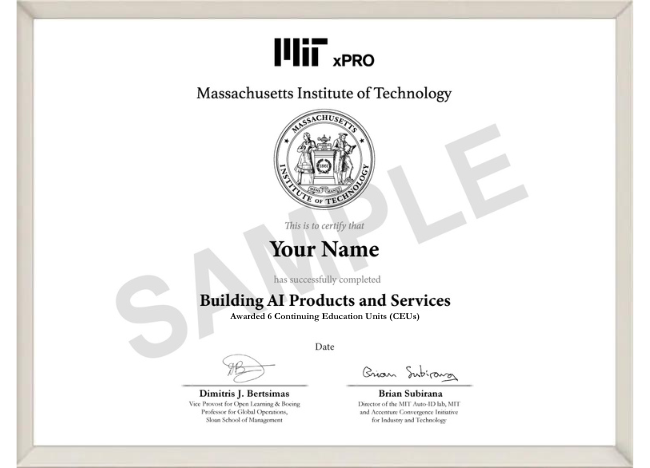
Certificate from MIT xPRO
Get recognized! Upon successful completion of this program, MIT xPRO grants a certificate of completion to participants and 6 Continuing Education Units (CEUs) . This program is graded as a pass or fail; participants must receive 75% to pass and obtain the certificate of completion.
Note: After successful completion of program, your verified digital certificate will be emailed, at no additional cost, in the name you used when registering for the program. All certificate images are for illustrative purposes only and may be subject to change at the discretion of MIT.
Registration for this program is done through Emeritus. You can contact us at mit.xpro@emeritus.org
This program is open for enrolments for residents of India, Bangladesh, Bhutan, Myanmar, Nepal, Pakistan, Sri Lanka, Philippines, Indonesia, Thailand, Vietnam and Malaysia only.
Note:
Learning facilitator details and office hour dates and timings are from previous batches. The learning facilitators may change for upcoming batches based on availability and the office hour timings and dates may be changed based on a mutually decided schedule between Emeritus and the Learning facilitator.
*Mentioned timelines are tentative.
Emeritus Career Services
15 recorded sessions and resources in the following categories
(Please note: These sessions are not live)
Resume And Cover Letter Building
Job Search Navigation
Interview Preparation
LinkedIn Profile Optimization
Access To Interview Preparation Guidebooks in Business Analytics and Data Science, Digital Marketing, And Product Management
Note:
MIT xPRO or Emeritus do not promise or guarantee a job or progression in your current job. Career Services is only offered as a service that empowers you to manage your career proactively. The Career Services mentioned here are offered by Emeritus. MIT xPRO is NOT involved in any way and makes no commitments regarding the Career Services mentioned here.
FAQs
The Program
How do I know if this MIT xPRO AI Products and Services program is right for me?
After reviewing the information on the program landing page, we recommend you submit the short form above to gain access to the program brochure, which includes more in-depth information. If you still have questions on whether this artificial intelligence course is a good fit for you, please email learner.success@emeritus.org, and a dedicated program advisor will follow-up with you very shortly.
Are there any prerequisites for this MIT xPRO AI Products and Services program?
Some AI and ML courses do have prerequisites, particularly the more technical ones. This information will be noted on the program landing page, as well as in the program brochure. If you are uncertain about program prerequisites and your capabilities, please email us at the ID mentioned above.
Note that, unless otherwise stated on the program web page, all programs are taught in English and proficiency in English is required.
What is the typical class profile?
More than 50 percent of our participants are from outside the United States. Class profiles vary from one cohort to the next, but, generally, our AI certificate courses draw a highly diverse audience in terms of professional experience, industry, and geography — leading to a very rich peer learning and networking experience.
What other dates will this program be offered in the future?
Check back to this program web page or email us to inquire if future dates for this artificial intelligence course or the timeline for future offerings have been confirmed yet.
How is the learning experience structured in the MIT xPRO AI Products and Services Program?
How much time is required each week?
Each program includes an estimated learner effort per week. This is referenced at the top of the program landing page under the Duration section, as well as in the program brochure, which you can obtain by submitting the short form at the top of this web page.
How will my time be spent?
We have designed this AI program to fit into your current working life as efficiently as possible. Time will be spent among a variety of activities including:
Engaging with recorded video lectures from faculty
Attending webinars and office hours, as per the specific program schedule
Reading or engaging with examples of core topics
Completing knowledge checks/quizzes and required activities
Engaging in moderated discussion groups with your peers
Completing your final project, if required
The program is designed to be highly interactive while also allowing time for self-reflection and to demonstrate an understanding of the core topics through various active learning exercises. Please email us if you need further clarification on program activities.
What is it like to learn online with the learning collaborator, Emeritus?
More than 300,000 learners across 200 countries have chosen to advance their skills with Emeritus and its educational learning partners. In fact, 90 percent of the respondents of a recent survey across all our programs said that their learning outcomes were met or exceeded.
All the contents of the course would be made available to students at the commencement of the course. However, to ensure the program delivers the desired learning outcomes the students may appoint Emeritus to manage the delivery of the program in a cohort-based manner the cost of which is already included in the overall course fee of the course.
A dedicated program support team is available 24/5 (Monday to Friday) to answer questions about the learning platform, technical issues, or anything else that may affect your learning experience.
How do I interact with other program participants?
Peer learning adds substantially to the overall learning experience and is an important part of this AI program. You can connect and communicate with other participants through our learning platform.
What is the relationship between Emeritus and MIT xPRO?
Emeritus and MIT xPRO collaborate to create and deliver educational programs.
What certificate will I receive from the MIT xPRO AI Products and Services Program?
What are the requirements to earn the certificate?
Each ai product development course includes an estimated learner effort per week, so you can gauge what will be required before you enroll. This is referenced at the top of the program landing page under the Duration section, as well as in the program brochure, which you can obtain by submitting the short form at the top of this web page. All programs are designed to fit into your working life.
This ai product development course is scored as a pass or no-pass; participants must complete the required activities to pass and obtain the certificate of completion. Some programs include a final project submission or other assignments to obtain passing status. This information will be noted in the program brochure. Please email us if you need further clarification on any specific program requirements.
What type of certificate will I receive?
Upon successful completion of the program, you will receive a smart digital certificate. The smart digital certificate can be shared with friends, family, schools, or potential employers. You can use it on your cover letter, resume, and/or display it on your LinkedIn profile. The digital certificate will be sent approximately two weeks after the program, once grading is complete.
Can I get the hard copy of the certificate?
No, only verified digital certificates will be issued upon successful completion. This allows you to share your credentials on social platforms such as LinkedIn, Facebook, and Twitter.
Do I receive alumni status after completing this program?
No, there is no alumni status granted for this program. In some cases, there are credits that count toward a higher level of certification. This information will be clearly noted in the program brochure.
How long will I have access to the learning materials?
You will have access to the online learning platform and all the videos and program materials for 12 months following the program start date. Access to the learning platform is restricted to registered participants per the terms of agreement.
Technical Requirements
What equipment or technical requirements are there for this MIT xPRO AI Products and Services program?
Participants will need the latest version of their preferred browser to access the learning platform. In addition, Microsoft Office and a PDF viewer are required to access documents, spreadsheets, presentations, PDF files, and transcripts.
Do I need to be online to access the MIT xPRO AI Products and Services program content?
Yes, the learning platform is accessed via the internet, and video content is not available for download. However, you can download files of video transcripts, assignment templates, readings, etc. For maximum flexibility, you can access program content from a desktop, laptop, tablet, or mobile device.
Video lectures must be streamed via the internet, and any livestream webinars and office hours will require an internet connection. However, these sessions are always recorded, so you may view them later.
Payment Process
Can I still register if the registration deadline has passed for this artificial intelligence course?
Yes, you can register up until seven days past the published start date of the program without missing any of the core program material or learnings.
What is the program fee, and what forms of payment do you accept?
The program fee is noted at the top of this program web page and usually referenced in the program brochure as well.
Flexible payment options are available (see details below as well as at the top of this program web page next to FEE).
Tuition assistance is available for participants who qualify. Please email mit.xpro@emeritus.org
What if I don’t have a credit card? Is there another method of payment accepted for this artificial intelligence course?
Yes, you can do the bank remittance in the program currency via wire transfer or debit card. Please contact your program advisor, or email us for details.
I was not able to use the discount code provided. Can you help?
Yes! Please email us with the details of the program you are interested in, and we will assist you.
How can I obtain an invoice for payment?
Please email us your invoicing requirements and the specific program you’re interested in enrolling in.
Is there an option to make flexible payments for this program?
Yes, the flexible payment option allows a participant to pay the program fee in installments. This option is made available on the payment page and should be selected before submitting the payment.
Who will be collecting the payment for the program?
Emeritus collects all program payments, provides learner enrollment and program support, and manages learning platform services.
Refund Policy
Refund Policy
Policy Communication:
Emeritus’ Withdrawal, Refund and Deferral policies are communicated to all learners (both existing and prospective) via the Emeritus website and Learning Management System. It is the learner’s responsibility to review, be aware of and adhere to these policies.
Withdrawal for Non-delivery of Course:
Emeritus will notify learners in writing if (a) the course will not commence on the scheduled course commencement date; (b) the course will not be completed by the scheduled course completion date; or (c) the learner does not meet the course entry or matriculation requirement as set by Emeritus or the university. Within three (3) working days of such notice, Emeritus will inform learners in writing of any available alternative study arrangements.
If a learner declines the offered alternative study arrangements, if any, or desires to otherwise withdraw from the course for the reasons stated in paragraph 2 above, the learner shall request a withdrawal from Emeritus within fifteen (15) calendar days. Upon receipt of the withdrawal request and validation of eligibility, Emeritus shall refund the learner 100% of course and miscellaneous fees previously paid by the learner, except that course application fees are non-refundable and non-transferable. Emeritus shall use commercially reasonable efforts to make such refund within seven (7) working days from receipt of the withdrawal request from learner.
Withdrawal for Other Reasons:
If the learner wishes to withdraw from the course or program for any reason other than those stated in paragraph 2 above, the following provisions shall control all withdrawal requests:
Absent a previous approved request for deferral for the course, learners may request a full refund of all course and miscellaneous fees paid, within fourteen (14) days after course commencement. Application fees for courses are non-refundable and non-transferable. Learners who have previously been granted a course deferral are not eligible for a refund for the course. Partial (or pro-rated) refunds are not offered. Emeritus shall use commercially reasonable efforts to make a valid refund within seven (7) working days from receipt of the withdrawal request from learner.
Emeritus reserves the right, in its sole discretion, to dismiss a learner from a course or program at any time and to provide a refund to the learner pursuant to the stated refund policy in paragraph 2 above. Learners who are dismissed from a course or program due to a violation of Emeritus’ Code of Conduct are not entitled to any refund.
How to Submit a Valid Withdrawal Request:
All withdrawal requests must be sent in writing within the timelines specified in paragraphs 2 or 3 above to:
All refunds will be paid directly to the original payer only, unless written and signed instruction is provided by the original payer to pay the refund to an account belonging to a person other than the original payer.
Bank Charges/Transaction Fees:
In the event of an approved refund, Emeritus will refund the course fee collected and will not be liable to refund any foreign transaction fees, processing charges, or any other bank fees.
Early Registrations Are Encouraged. Seats Fill Up Quickly!
Flexible payment options available.
Starts On