


Designing and Building AI Products, Services, and Agentic Solutions
Empower yourself to turn AI opportunities into business-ready solutions
MIT xPRO Designing and Building AI Products, Services, and Agentic Solutions Program: Move Beyond AI Possibilities to AI Implementation
Designing and Building AI Products, Services, and Agentic Solutions is a 10-week online program from MIT xPRO. It equips professionals to evaluate AI opportunities, design intelligent products, services, and workflows, and connect AI capabilities to meaningful business value and implementation. You will explore generative AI (gen AI), retrieval-augmented generation (RAG), model context protocol (MCP), agentic AI, embedded AI, machine learning (ML), deep learning (DL), and physical AI to make informed decisions about where AI can create value and where human judgment remains essential.
Through hands-on activities and a progressive capstone, gain the confidence and capability to evaluate AI opportunities, design intelligent solutions, and advance them toward implementation which will empower you to move from AI possibilities to purposeful action.
What Will You Learn in the Designing and Building AI Products, Services, and Agentic Solutions Program?
Program Highlights

AI Foundations
Follow an end-to-end learning journey spanning AI, machine learning, deep learning, generative AI, RAG, MCP, and agentic systems through deployment strategy and value realization

Capstone Project
Progressively apply each module to an industry or organizational pain point, and develop a workplace-ready AI Implementation Plan

Emerging Technologies
Explore emerging areas such as physical AI, embedded AI, intelligent human-computer interaction, personal agents, and human-machine superminds

Flexible Learning
Use multiple learning pathways, including Excel, web-based environments, and Python, to explore AI concepts and applications

MIT Faculty Insights
Learn from MIT faculty perspectives, research examples, and Media Lab demonstrations, connecting foundational concepts with emerging applications

Applied Learning
Evaluate AI limitations, design RAG requirements, develop MCP specifications, map agentic workflows, prioritize AI opportunities, and build an evidence-based business case through hands-on activities

Business Readiness
Apply a business-outcome-first approach addressing key performance indicators (KPIs), data readiness, workforce impact, human oversight, implementation risk, build-versus-buy decisions, and scale-or-stop criteria
How is the Designing and Building AI Products, Services, and Agentic Solutions Program Curriculum Structured?
Explore an end-to-end curriculum that connects AI technologies, solution design, deployment readiness, and business value. Build the capabilities to evaluate AI opportunities, select fit-for-purpose approaches, design intelligent solutions, and develop an implementation plan based on your organization’s priorities.
1
Module 1: The AI Design Process: Designing Products and Solutions across AI and Agentic Technologies
Learn how prompting influences transformer-based and agentic AI systems
Differentiate the roles of orchestration, transformer-based large language models (LLMs), traditional machine learning, and agentic AI in AI systems
Define an AI opportunity by identifying a business or user pain point, intended intelligent behavior, and desired business outcomes
Match the stages of the AI design process to the key decisions involved in designing AI products and services
Evaluate key risks and implementation considerations associated with AI systems, including bias, guardrails, hallucinations, and maintenance considerations
Develop an AI design foundation using the four-stage AI design process for a proposed AI solution
2
Module 2: From Models to Applications Part 1: Machine Learning Methods
Differentiate between machine learning methods
Run machine learning algorithms in Python
Implement deep learning techniques in Python
Assess whether a linear classifier is suitable for a business decision
Select appropriate machine learning and deep learning methods for different problem types
Assess the machine learning method fit for an industry pain point
3
Module 3: From Models to Applications Part 2: Generative AI, Transformers, GANs and RAGs
Run a simple generative adversarial network (GAN) in Python
Analyze a simple GAN in Python
Extract token embeddings for natural language processing tasks
Differentiate between the core components of generative AI systems
Compare generative AI capabilities and limitations across business applications
Apply the RAG pipeline design process to a real-world use case
Demonstrate how AI can solve healthcare problems
Evaluate how transformer architectures create value across organizational use cases
Recommend an appropriate generative AI approach to address an organizational pain point based on capabilities, limitations, and contextual requirements
4
Module 4: From Models to Applications Part 3: Agentic AI, MCP and Multimodal AI
Apply a transformer limitation framework to a domain-specific organizational task
Design a multimodal AI architecture
Build an MCP server specification for a domain-specific organizational task
Design an always-on agentic AI system using scheduling, channels, and skills
Apply a capability framework and transformer extensions, including chain of thought, tools, MCP, and agentic AI, to a domain-specific organizational pain point
5
Module 5: Designing Physical AI and Human–Computer Interfaces
Explore assumptions about what AI can and cannot do across on-screen and physical examples
Identify AI systems’ failures when producing physically functional products
Define possible solutions that close the gap between visual plausibility and real-world functionality of physical AI
Predict changes initiated by physical AI systems that act in the real world
Evaluate safety, trust, responsibility, and human oversight needs for AI systems that act autonomously in the physical world
6
Module 6: AI-Enabled Apps and Media Applications
Explain why and how embedded AI changes the way products, services, and business interactions must be designed
Locate examples, resources, or practices that show how AI is being embedded inside or near an industry
Analyze how AI-powered visualization can reveal a whole information landscape, break silos, and surface opportunities or trends
Synthesize seemingly unrelated AI examples into transferable patterns that can reframe a professional, personal, or industry pain point
Evaluate how embedded AI approaches address pain points in personal and professional endeavors as well as across industries
7
Module 7: Human-Machine Collaboration and Superminds
Discuss how people and computers can work together
Analyze how group intelligence can include computers
Compare the five types of superminds
Discuss the five basic types of cognitive processes and how superminds can be used to enhance them
Assess the value of computers in prediction markets
Appraise the value of computer integration in community superminds
Evaluate various superminds to address a business function
Evaluate the collective intelligence of a group
Justify the use of superminds to address a business problem
8
Module 8: Deploying, Scaling, and Operating AI Systems
Analyze AI use cases using business outcomes, data requirements, and workforce considerations
Map the major steps and KPIs for a selected process
Classify process steps by AI deployment fit using data, technology, and workforce
Prioritize AI opportunities using business value and execution risk
Classify AI deployment opportunities by workforce impact
Assess implementation readiness for a prioritized AI opportunity
9
Module 9: AI Business Cases and Value Realization
Develop a business case for an AI implementation
Apply the double diamond framework to design a measurable AI pilot
Develop a measurable AI Implementation Plan for a selected organizational pain point
Diagnose implementation challenges using AI case studies and readiness criteria
Analyze the disruptive potential of generative or agentic AI using Christensen’s theory of disruption
Hear from the MIT xPRO Designing and Building AI Products, Services, and Agentic Solutions Faculty
“The challenge with AI is not simply understanding what these technologies can do but knowing where they can create meaningful value. Professionals need to understand when AI is appropriate, which approaches fit different problems, how to design effective AI systems, and where human judgment remains essential. The next wave of AI will extend beyond today’s tools into systems that can act, interact, and operate in the physical world, making it increasingly important for businesses to understand emerging capabilities before they become mainstream. This program brings these perspectives together, helping professionals move from AI opportunities to solutions that can be evaluated, implemented, and connected to measurable business value.”

Brian Subirana
Former Director, MIT Auto-ID Lab
Key Takeaways
By the end of the program, you will be able to:
Evaluate the stages of the AI design process model
Categorize different AI and machine learning algorithms (e.g., convolutional, deep, and different types of transformers)
Design, build, and use Agentic AI systems that orchestrate business activities
Apply the tools and techniques of generative and Agentic AI at the employee and organizational levels
Develop specifications for AI solutions using RAG, chain-of-thought reasoning, tools, and Agentic AI capabilities
Explain how humans and computers interact in AI systems
Describe how different types of superminds address various problems
Predict AI opportunities in digital business processes
Build a business case for initiating an AI application, including deciding what to build in-house versus outsourcing
How Does the Designing and Building AI Products, Services, and Agentic Solutions Program Prepare You to Drive Real-World AI Impact?
Faculty Live Sessions
Session 1: The Agentic AI Landscape — Present and Future
Examine the evolving agentic AI landscape and how leading organizations are building sustainable advantage on the path toward artificial general intelligence. Review recent developments shaping the industry, explore likely priorities for the next 12 months, and assess longer-term scenarios. Learn how to evaluate closed- and open-source AI options using a practical scorecard, and understand when combining multiple approaches may be most effective.
Session 2: Emerging Standards for Agentic AI — Model Context Protocol and Beyond
Explore why standards are becoming critical as agentic AI applications scale. Gain a detailed understanding of the MCP, and examine additional emerging standards that support trustworthy, interoperable, and autonomous agent behavior.
Session 3: Case Study — Building an Agentic Platform from the Ground Up
Analyze a real-world agentic customer service case study, examining the business drivers, system architecture, and tools required to build and deploy an AI agent. Review representative design patterns and implementation elements, and explore additional use cases to understand the broader potential of agentic platforms.
Note: Live session content is subject to change. The above topics are addressed through faculty-led sessions and complement the core module instruction.
Case Studies and Industry Examples
Radiology (automation versus job redesign): The radiology case shows that automating one activity does not automatically replace an occupation because AI changes how work is organized, reviewed, and supported
Garfield (bounded agentic AI): Garfield shows how agentic AI can perform specialized tasks inside a narrow, regulated legal workflow while humans supervise, approve consequential actions, and remain accountable
MEDVi (AI-enabled operating model): MEDVi shows how a very small internal team can use agentic AI to orchestrate digital operations while outsourced providers perform specialized medical, legal, financial, and physical work
Gynecological decision-making case study: A 40-year-old woman considering pregnancy with donor sperm receives conflicting recommendations from specialists, creating an ambiguous scenario used to test whether an LLM can identify meaningful alternatives beyond the two prominent options
MRI/Alzheimer’s disease healthcare application: This case study examines transformer-based AI in a healthcare setting in which medical imaging and other patient information contribute to decision making while human expertise remains important
RAG: This case study shows how organizations can turn existing knowledge assets, such as help desk records, contracts, news archives, and prior communications, into searchable resources that help AI generate more accurate, context-aware, and organization-specific responses
ImageNet-to-Waymo example: This case study offers optional content used to distinguish an important technological capability or research breakthrough from the point at which that capability becomes sufficiently mature to support a valuable real-world application
MechStyle: MechStyle shows a system that uses physical simulation to help AI-generated designs meet mechanical requirements rather than merely achieving a desired visual appearance
Latent Lab: This case study introduces an MIT Media Lab experiment in information cartography that uses embeddings and dimensionality reduction to transform large collections of raw, unstructured information into navigable visual maps
Biopharmaceutical process control agent: An agent reads production data, applies machine learning algorithms, and rapidly recommends changes to process parameters while retaining a human operator for the final decision
Proven Frameworks and Models
The four-stage AI design process (four AI-empowering activities)
Four framing concepts for embedded AI
AI impact matrix
Value-versus-risk prioritization framework
Data readiness/digital hierarchy of needs
Double diamond framework
Pilot purgatory framework
Capstone Project
The Designing and Building AI Products, Services, and Agentic Solutions program offers a longitudinal, problem-centered capstone that begins with a meaningful organizational or business pain point and progressively investigates how AI can address it. Across the program, you will apply AI capabilities, tools, and methods to clarify the problem, evaluate possible approaches, test the current AI frontier, and identify its limitations. You will design a human-AI workflow and develop a prototype or validated solution concept, choosing the approach that best fits the problem rather than forcing every challenge into an LLM solution. The capstone culminates in an integrated solution and business-facing presentation that communicates the opportunity, design choices, evidence, value, risks, and implementation considerations.
Who Is the Designing and Building AI Products, Services, and Agentic Solutions Program For?
The Designing and Building AI Products, Services, and Agentic Solutions program is designed for professionals across technology, product, consulting, entrepreneurship, and user interface (UI) and user experience (UX) who are responsible for evaluating AI opportunities, designing AI-enabled products and solutions, and advancing them toward implementation and business value.
Technical product managers and leaders responsible for machine learning and AI-based initiatives within their organizations | Evaluate AI opportunities and apply modern AI approaches to design products, services, and solutions that create business value. |
Technology professionals who design and develop technology solutions aligned to organizational needs | Build expertise in evaluating AI approaches, designing intelligent workflows, and developing AI-enabled products and solutions. |
Technology consultants | Strengthen capabilities in identifying AI opportunities, designing AI-enabled solutions, and advising clients on implementation and value creation. |
Entrepreneurs building AI-driven applications, products, or services | Learn frameworks for identifying opportunities, designing AI-powered offerings, and evaluating build-versus-buy and implementation decisions. |
UI/UX designers and leaders | Develop capabilities for designing intelligent interfaces, human–AI interactions, and AI-enabled user experiences. |
AI and technology enthusiasts, including aspiring AI product makers and curious learners | Stay ahead of developments in gen AI, RAG, agentic AI, physical AI, intelligent workflows, and AI-powered products and services. |
Note: The content of this program assumes previous knowledge of calculus, linear algebra, statistics, and probability. Basic Python experience will also be beneficial.
Meet the Designing and Building AI Products, Services, and Agentic Solutions Program Faculty

Brian Subirana
Former Director, MIT Auto-ID lab
Brian Subirana holds a PhD in AI from MIT’s Computer Science and Artificial Intelligence Laboratory (CSAIL) and an MBA from the MIT Sloan School of Management. He is also Prof...

Dr. Thomas W. Malone
Patrick J. McGovern (1959) Professor of Management, MIT Sloan School of Management
Dr. Thomas W. Malone is the Patrick J. McGovern (1959) Professor of Management at the MIT Sloan School of Management and the founding director of the MIT Center for Collective...

Dr. Stefanie Mueller
Joint Associate Professor, MIT Electrical Engineering and Computer Science and MIT Mechanical Engineering
Dr. Stefanie Mueller is a joint associate professor between MIT Electrical Engineering and Computer Science and MIT Mechanical Engineering. She is also a member of CSAIL. In h...

Dr. Duane S. Boning
Vice Provost for International Activities at MIT
Dr. Duane S. Boning is the Clarence J. LeBel Professor in Electrical Engineering and a professor of electrical engineering and computer science in the Electrical Engineering a...

Dr. Andrew Lippman
Senior Research Scientist, MIT, and Associate Director, MIT Media Lab
Dr. Andrew Lippman is a senior research scientist at MIT and associate director of the Media Lab. He has been with the Lab since its inception. His work there has ranged from ...

Bruce Lawler
Entrepreneur and Executive Leader
Bruce Lawler is an entrepreneur and executive leader with consecutive public and private exits and early-stage investing success with leading venture organizations, including ...
Meet the Guest Speaker

Gauri Agarwal
Chief Technology Officer and Co-Founder, Koyal AI
Gauri Agarwal is the chief technology officer and co-founder of Koyal AI, a gen AI startup that turns scripts, audio, and dialogue into cinematic films. At Koyal, she helps le...
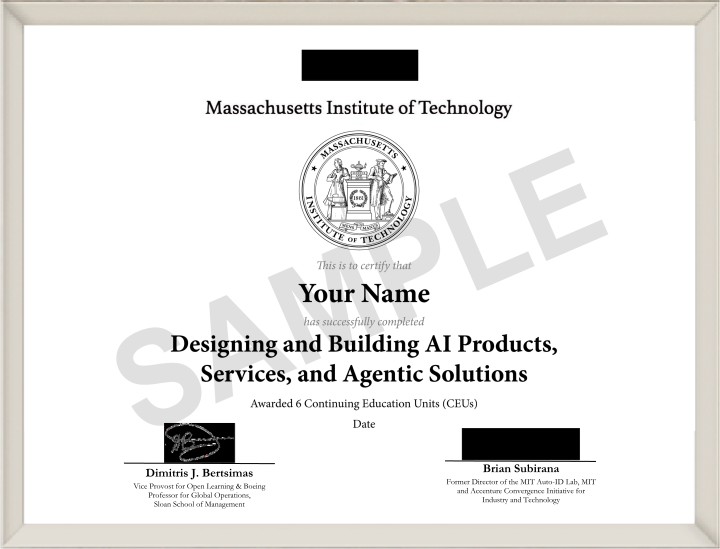
What Credentials and Outcomes Will You Gain from the Designing and Building AI Products, Services, and Agentic Solutions Program?
Upon successful completion of the Designing and Building AI Products, Services, and Agentic Solutions program, MIT xPRO grants participants a certificate of completion. This program is graded as pass or fail; participants must receive a minimum score of 70% to pass and obtain the certificate of completion.
After successful completion of the program, your verified digital certificate will be emailed to you, at no additional cost, in the name you used when registering for the program. All certificate images are for illustrative purposes only and may be subject to change at the discretion of MIT xPRO.
Note: After successful completion of program, your verified digital certificate will be emailed, at no additional cost, in the name you used when registering for the program. All certificate images are for illustrative purposes only and may be subject to change at the discretion of MIT.
Receive an executive certificate with this learning journey
AI Strategy and Product Innovation
Lead AI Innovation from Strategy Implementation to Product Development
Experience a comprehensive learning journey with MIT xPRO, combining two popular executive programs to enhance your expertise in the new world of AI. This integrated approach blends cutting-edge AI insights with strategic leadership frameworks, equipping professionals to develop AI-driven products, implement AI solutions at scale, and lead transformation within their organizations.

Registration for this program is done through Emeritus. You can contact us at learner.success@emeritus.org
Frequently Asked Questions
1
The Program
What is the Designing and Building AI Products, Services, and Agentic Solutions program?
The Designing and Building AI Products, Services, and Agentic Solutions program is a 10-week online MIT xPRO program designed to help professionals move from AI possibilities to purposeful action. It combines artificial intelligence, machine learning, generative AI, RAG, MCP, agentic AI, physical AI, embedded AI, and human–machine collaboration.
You will:
Evaluate AI systems and opportunities based on business and user needs
Design intelligent products, services, and workflows
Develop a workplace-ready AI Implementation Plan
Is this an agentic AI course or a broader AI program?
The program takes an end-to-end approach to AI product management and business solution design, exploring agentic AI among several emerging capabilities. You will examine how different AI approaches can be matched to business challenges and used to design intelligent solutions.
The curriculum covers:
Agentic AI systems, orchestration, tools, and MCP
AI workflows and always-on agentic systems
Human oversight, guardrails, and implementation considerations
What will I learn about AI agents?
You will explore how AI agents can be designed and incorporated into intelligent workflows and business solutions. The curriculum focuses on understanding agent capabilities, orchestration, tools, and the role of human judgment.
You will:
Design agentic workflows using scheduling, channels, and skills
Explore tool use, MCP, and orchestration
Consider human intervention, guardrails, maintenance, and oversight
Does the program cover RAG system design and retrieval augmented generation?
RAG is a key part of the curriculum, with learners applying retrieval-augmented generation to real-world use cases of gen AI. The program focuses on understanding when RAG is appropriate and how it can extend the capabilities of transformer-based AI.
You will:
Apply a RAG pipeline to a real-world use case
Explore RAG system design in a business context
Evaluate the capabilities and limitations of different approaches
Does the program cover Model Context Protocol and AI orchestration?
Model Context Protocol is explored as part of the program's treatment of AI tools, orchestration, and agentic AI systems. Through this AI product strategy training, you will develop the AI product road map, examine how AI can connect with external capabilities, and design an MCP server specification.
You will work with:
Multi-agent orchestration concepts and AI orchestration
Integrating external tools through MCP
Designing agentic workflows around specific business needs
Is the MIT xPRO Designing and Building AI Products, Services, and Agentic Solutions program worth it?
The MIT xPRO Designing and Building AI Products, Services, and Agentic Solutions program equips professionals with practical frameworks and capabilities to evaluate AI opportunities, design intelligent products and solutions, assess implementation readiness, and connect AI to meaningful business value. The program is best suited for professionals seeking structured, MIT xPRO-backed development to move from AI possibilities to purposeful action and apply AI effectively within their organizations.
2
The Learning Experience
What practical skills will I develop?
The program develops practical skills across AI evaluation, solution design, technical exploration, and implementation planning. Hands-on activities help connect technical concepts with real business and organizational challenges.
You will develop skills in:
Prompt engineering and AI orchestration
RAG system design and MCP specification
Building AI agents and designing AI workflows
AI agent development training
Business case development and implementation planning
Does the program include hands-on projects?
Hands-on learning is integrated throughout the program, giving you opportunities to apply AI concepts rather than only study them. Activities span technical experimentation, AI solution design, and business applications.
Examples include:
Python-based machine learning and deep learning exercises
Advanced prompting techniques, tokenization, embeddings, and GANs
Designing RAG systems, MCP specifications, and agentic systems
Will I work with real-world applications of AI?
The curriculum connects AI technologies to real-world applications across different industries and organizational contexts. You will examine how AI capabilities can address specific pain points and create value.
Applications include:
Healthcare AI and manufacturing use cases
Physical AI and embedded AI
AI solutions applied to an industry or organizational pain point
Does the program teach responsible AI and human-centered AI?
Responsible and human-centered considerations are integrated into the design and implementation of AI solutions. You will consider the technical, human, and organizational implications of deploying intelligent systems.
You will explore:
Responsible AI design practices, including bias, hallucinations, and guardrails
Human-centered AI, trust, safety, and human oversight
Workforce impact and human–machine collaboration
What is the capstone experience, and will I complete a real-world project?
The progressive capstone centers on an industry or organizational pain point and culminates in a workplace-ready AI Implementation Plan. You will bring together technical, human, operational, and strategic perspectives to determine what it takes to move an AI opportunity toward implementation.
The capstone will help you:
Assess AI capability fit, including gen AI and agentic AI
Evaluate deployment options, costs, workforce readiness, and business value
Develop a measurable implementation plan with stakeholder actions and clear scale-or-stop criteria
Does the program teach prompt engineering and chain-of-thought prompting?
The program explores how prompting influences transformer-based and agentic AI systems, with applications relevant to product leaders and professionals working with AI solutions.
You will:
Build skills in prompt engineering for product manager decision making
Explore chain-of-thought prompting and AI system behavior
Apply prompting concepts to AI workflows and solution design
3
Certification
What are the requirements to earn the certificate?
Each program includes an estimated learner effort per week, so you can gauge what will be required before you enroll. This is referenced at the top of the program landing page under the Duration section, as well as in the program brochure, which you can obtain by submitting the short form at the top of this web page. All programs are designed to fit into your working life.
This program is scored as a pass or no-pass; participants must complete the required activities to pass and obtain the certificate of completion. Some programs include a final project submission or other assignments to obtain passing status. This information will be noted in the program brochure. Please email us if you need further clarification on any specific program requirements.
What type of certificate will I receive?
Upon successful completion of the program, you will receive a smart digital certificate. The smart digital certificate can be shared with friends, family, schools, or potential employers. You can use it on your cover letter, resume, and/or display it on your LinkedIn profile.The digital certificate will be sent approximately two weeks after the program, once grading is complete.
Can I get the hard copy of the certificate?
No, only verified digital certificates will be issued upon successful completion. This allows you to share your credentials on social platforms such as LinkedIn, Facebook, and Twitter.
Do I receive alumni status after completing this program?
No, there is no alumni status granted for this program. In some cases, there are credits that count toward a higher level of certification. This information will be clearly noted in the program brochure.
How long will I have access to the learning materials?
You will have access to the online learning platform and all the videos and program materials for 24 months following the program start date. Access to the learning platform is restricted to registered participants per the terms of agreement.
Does this MIT xPRO artificial intelligence program provide an AI certification?
The Designing and Building AI Products, Services, and Agentic Solutions program is a certificate program, and it does not provide any AI certifications. However, earning a certificate from MIT xPRO in AI product and solution design demonstrates both strategic insight and technical proficiency. It will help display your ability to lead AI product initiatives and apply advanced AI concepts to solve business challenges.
4
Technical Requirements
What equipment or technical requirements are there for this program?
Participants will need the latest version of their preferred browser to access the learning platform. In addition, Microsoft Office and a PDF viewer are required to access documents, spreadsheets, presentations, PDF files, and transcripts.
Do I need to be online to access the program content?
Yes, the learning platform is accessed via the internet, and video content is not available for download. However, you can download files of video transcripts, assignment templates, readings, etc. For maximum flexibility, you can access program content from a desktop, laptop, tablet, or mobile device.
Video lectures must be streamed via the internet, and any livestream webinars and office hours will require an internet connection. However, these sessions are always recorded, so you may view them later.
5
Payment Process
Can I still register if the registration deadline has passed?
Yes, you can register up until seven days past the published start date of the program without missing any of the core program material or learnings.
What is the program fee, and what forms of payment do you accept?
The program fee is noted at the top of this program web page and usually referenced in the program brochure as well.
Flexible payment options are available (see details below as well as at the top of this program web page next to FEE).
Tuition assistance is available for participants who qualify. Please email learner.success@emeritus.org.
What if I don’t have a credit card? Is there another method of payment accepted?
Yes, you can do the bank remittance in the program currency via wire transfer or debit card. Please contact your program advisor, or email us for details.
I was not able to use the discount code provided. Can you help?
Yes! Please email us with the details of the program you are interested in, and we will assist you.
How can I obtain an invoice for payment?
Please email us your invoicing requirements and the specific program you’re interested in enrolling in.
Is there an option to make flexible payments for this program?
Yes, the flexible payment option allows a participant to pay the program fee in installments. This option is made available on the payment page and should be selected before submitting the payment.
How can I obtain a W9 form?
Please connect with us via email for assistance.
Who will be collecting the payment for the program?
Emeritus collects all program payments, provides learner enrollment and program support, and manages learning platform services.
Are there any restrictions on the types of funding that can be used to pay for the program?
Program fees for Emeritus programs with MIT xPRO may not be paid for with (a) funds from the GI Bill, the Post-9/11 Educational Assistance Act of 2008, or similar types of military education funding benefits or (b) Title IV financial aid funds.
6
Refund Policy
What is the program refund and deferral policy?
For the program refund and deferral policy, please click the link here.
7
Accessibility
How does Emeritus support accessibility for learners?
Emeritus is committed to making high-quality education accessible and affordable to individuals, companies, and governments around the world. If you have questions about accessibility or would like to discuss available support options before enrolling, please contact accessibility@emeritus.org. For more information about our accessibility practices, please review our Accessibility Policy here.
Financing Options
Climb Credit*
We offer financing options with our partner, Climb Credit*. Click here to learn more.
Flexible Payment Options For All
Flexible payment options allow you to pay the program fee in installments. Click here to see payment schedule.
Didn't find what you were looking for? Write to us at learner.success@emeritus.org or Schedule a call with one of our Academic Advisors or call us at +1 401 443 9591 (US) / + 44 189 236 2347 (UK) / +65 3129 7174 (SG)
Flexible payment options available.
Starts On