

Batch 20
Post Graduate Certificate in Cybersecurity
- #1 Private University as per QS Global World Ranking 2025
- Earn a certificate from MIT xPRO and 40 CEUs
- Live masterclass on Gen AI and cybersecurity tools by industry experts
Round Application Deadline
Upcoming application deadline: Invalid liquid data Invalid liquid data + GST
Program Overview
This is what joining the Post Graduate Certificate in Cybersecurity from MIT xPRO will teach you while developing your capability and giving your resume the MIT xPRO advantage! It's an immersive certificate program that will provide you with a comprehensive introduction to cybersecurity focused on the defensive and offensive aspects of technology. You will also benefit from receiving personalized feedback from program leaders, insights from guest speakers, career coaching, mentorship from leading faculty who are thought leaders in the field, and the opportunity to create a capstone network development project for a job portfolio.
5 Million
$697 B
Get a Headstart with a Personalized Tour. Watch this!

Program Highlights

Earn a certificate from MIT xPRO to elevate your credentials

Insights and case studies from renowned MIT faculty

Market-ready cybersecurity skills in a high-growth market

Capstone presentation project to share with potential employers

Access to cutting-edge tools and frameworks from MIT faculty

Bi-weekly doubt clearing session with program leader

Live Masterclasses with program leader for hands-on learning
Program Details
280
58
34
50+
Note:
*This is an online program with pre-recorded video lectures. Thus, faculty will not be a part of bi-weekly live sessions or any other live interaction in this program. We have a curated panel of eminent industry practitioners who will be conducting the bi-weekly live doubt-clearing sessions.
**Assignments are graded either by industry practitioners who are available to support participants in their learning journey and/or by the Emeritus grading team. The final number of quizzes, assignments and discussions will be confirmed closer to the program start.
Program Frameworks
National Institute of Standards and Technology (NIST) Framework
The NIST CSF framework is threaded throughout the entire program as a commonly used framework. It is a widely used cybersecurity framework that encompasses guidelines for organizations to prepare themselves against cybersecurity attacks.
Cloud Security Alliance (CSA) Cloud Controls Matrix (CCM)
The Cloud Security Alliance (CSA) Cloud Controls Matrix (CCM) is discussed in the defensive cybersecurity section. This framework includes domains covering the aspects of cloud technology.
MITRE ATT&CK®
The MITRE ATT&CK® knowledge base is explored deeper in the offensive and defensive pieces of this program. It contains adversary tactics and techniques that are utilized as the foundational development of specific threat models and methodologies.
Live Masterclasses with Program Leader
Emerging cyber threats in Indian context
How Generative AI can reduce cyber-crimes in organizations
Live demo session on trending cybersecurity tools such as Burp Suite, Nmap, John The Ripper, Nessus essentials
Preparing learners for CompTIA Pentest+ certification
Tools Covered







Note: The tools will be taught by teaching faculty, industry practitioners, or linked to relevant knowledge bases for your reference and self-guided learning.
Case Studies

The Solar Winds supply chain attack of 2020, which compromised several thousand Orion users

The Saudi Aramco cyberattack of 2012 which wiped out 35000 computers and put the operations of the biggest oil company in the world at risk
The Cisco debacle of 2018 where a Cisco engineer broke through the security of Cisco, accessed 456 virtual machines and deleted 16000 Webex accounts
The MIRAI botnet attack of 2016, a severe DDOS attack which rendered much of the internet of the US east coast inaccessible

A study of the cyberculture and best practices in Cybersecurity on Verizon media

The Ukraine PowerGrid attack of 2015 which blew power for 200000+ consumers for 1-6 hours in Ukraine

The Baltimore ransomware attack of 2019 where Baltimore city was attacked by the aggressive ransomware RobbinHood costing more than $18mn
Who Is this Program for?
Mid-level and Senior-level career professionals who have established their careers in information technology and are looking to improve their organization's preparedness and response against cyberattacks and grow their career as leaders in cybersecurity strategies will benefit most from this program.
Additionally, graduates and early career professionals with or without prior experience in the IT field who want to specialize in cybersecurity from a globally recognized school and accelerate their career in a high-growth field with high-demand job opportunities will benefit from this program.
Program Modules
Module 1: Introduction to Cybersecurity Risk Management
Foundations of cybersecurity
Current events
Protecting organizations
Cybersecurity as risk management
Cybersecurity as an organization
Module 2: Cybersecurity Foundation Concepts
Basic concepts of cybersecurity
Isolation, sharing and access
Secure implementation
Privilege separation
Module 3: Federal Government’s Role: Laws, Operations, and Standards
Laws: Federal, State, And International
Federal criminal law, data breach
Privacy
Cybersecurity frameworks: NIST/CIS/SOC GDPR
Indian Cybersecurity laws
Module 4: Threats and Vulnerabilities
Threats: Disruption Of Operations And Attacks On Internet Of Things (IoT) And Equipment
Vulnerabilities : Basic technical attacks
Vulnerability analysis and management
Social engineering attacks
Publicizing threats
Module 5: Cybersecurity and Critical Urban Infrastructure
Initial Communication With A Client Agency
Preparing a vulnerability assessment
Vulnerability management processes, challenges and opportunities
Module 6: IAM(Identity Access Management) Concepts
IAM Principles and Concepts
Identification
Authentication
Authorization to Resources and Audit and Accountability
Business Context
IAM Training and Testing
IAM Policy Standards and procedure
Module 7: Layers of IAM and Technologies
Session Management
Client IAM
Network IAM
Data IAM Control Techniques
Risks and Controls
SSO
FIM Concepts
IAM Industry
Module 8: Preparing for a Job in Cybersecurity Risk Management
IAM Role
Frameworks
Third-party risks
Security roles and security organizations
Defence in Depth
Module 9: Intro to Defensive Cybersecurity
Repercussions of inadequate defence
Applying the NIST model
Défense in depth
Security processes
Layers of defence and security processes
Module 10: Cryptography
Networking Communication
Securing data
Message Authentication code
Hash functions
Encryptions and signatures
Certificates and channels
Module 11: Security Operations Centre
SOC performers services and tools
Analysts
Reactive and automatic Threat detection
Services and tools for threat detection
SOC roles and skills
Module 12: Incident Response
IR overview
IR Key components(detection and analysis)
Containment, Eradication and Recovery
Reflection
IR Roles and responsibilities
Module 13: Secure Systems Administration
Importance of secure administration and the administration role
Best practices
Combating threats
Proactivity
Validating
Module 14: Secure Network Administration
Terms and technology
Importance of security network administration
Strategies of network security administration
Standard policies and frameworks
Module 15: Cloud Security
Cloud computing
Cloud services models and deployment
Security and infrastructure management
Role of cloud in zero-trust security
Ransomware
Cloud security alliance (CSA)
Cloud Controls Matrix
Azure vs AWS vs GCP
Module 16: Preparing for a Job in Cybersecurity Operations
Terms and technology
Importance of security network administration
Strategies of network security administration
Standard policies and frameworks
Module 17: Intro to Offensive Cybersecurity
Security architecture and strategy
Threat modelling
The Red Team and penetration testing
NIST CSF and offensive cybersecurity
The Attacker mindset
Security assessment, evaluation and testing cycle
Module 18: Penetration Testing Part 1
Intro to penetration testing
Concepts and foundations
Why penetration testing is conducted
When is Penetration testing performed
Frameworks of penetration testing
Penetration testing professionals
Module 19: Penetration Testing Part 2
Penetration Testing planning, goals, objectives and scope
Discovery and reconnaissance
Enumeration
Vulnerability mapping
Access
Red Team/Blue team
Reporting
Module 20: Social Engineering
Social Engineering concepts
Types of social engineering
Phishing and its variants
Email hacks
Reducing risk
Social engineering: roles and responsibilities
Module 21: Artificial Intelligence
AI and ML
Settings and challenges
Malware detection
Models and neural networks
Preparation and modifications
Module 22: Policy and Privacy, Regulation, and Data Governance
Principles and laws
Data breaches
Terms
Design approaches
Privacy impact assessments
Module 23: OT and IoT Risk
IOT and OT concepts
Problems with IOT
Vulnerabilities of IOT, Operational Technology (OT)
Mitigations
Module 24: Preparing for a Job in Offensive Cybersecurity Operations
Concluding topics
Cybersecurity toolkit
Positions and skills
Professional advice
Program Pillars
Pillar 1: Introduction to Cybersecurity
The first three months of this program serve as an introduction to cybersecurity with a focus on fundamental concepts and IAM (identity and access management).
Pillar 2: Defensive Cybersecurity
The second set of three months focus on defensive cybersecurity. Take a deeper dive into concepts that include cryptography, SOC (security operations center), IR (incident response), secure systems and network administration, and cloud security.
Pillar 3: Offensive Cybersecurity
The next set of months address the importance of offensive cybersecurity through topics such as penetration testing, social engineering, artificial intelligence, privacy, regulation and data governance, and OT (Operational Technology) and IoT (Internet of Things) risk.
Gain the MIT xPRO Advantage
#1
98
26
Program Faculty

KERI PEARLSON
Executive Director of Cybersecurity at MIT Sloan (CAMS): The Interdisciplinary Consortium for Improving Critical Infrastructure Cybersecurity at the MIT Sloan School of Management
Dr. Pearlson is the executive director of Cybersecurity at MIT Sloan: The Interdisciplinary Consortium for Improving Critical Infrastructure Cybersecurity (IC)3. Pearlson has ...

NICKOLAI ZELDOVICH
Professor of Electrical Engineering and Computer Science, and a member of the Computer Science and Artificial Intelligence Laboratory at MIT
Dr. Zeldovich is a professor of electrical engineering and computer science at MIT and a member of the Computer Science and Artificial Intelligence Laboratory. He received his...

DANIEL J. WEITZNER
3Com Founders Principal Research Scientist, Founding Director, MIT Internet Policy Research Initiative, MIT Computer Science and Artificial Intelligence Lab
Daniel Weitzner is the founding director of the MIT Internet Policy Research Initiative and principal research scientist at CSAIL. In addition, he teaches internet public poli...

STUART MADNICK
John Norris Maguire Professor of Information Technologies, Emeritus, Sloan School of Management, Professor of Engineering Systems, School of Engineering and Founding Director, research consortium Cybersecurity at MIT Sloan (CAMS)
Dr. Madnick is the John Norris Maguire Professor of Information Technologies, Emeritus at the MIT Sloan School of Management and the founding director of Cybersecurity at MIT ...

LARRY SUSSKIND
Ford Professor of Urban and Environmental Planning, MIT Vice Chair and Co-founder, Program on Negotiation at Harvard Law School
Prof. Susskind's research interests focus on the theory and practice of negotiation and dispute resolution, the practice of public engagement in local decision-making, cyberse...

UNA-MAY O'REILLY
Principal Research Scientist and Leader of ALFA Group at MIT-CSAIL
Dr. O'Reilly's research group, AnyScale Learning for All, develops new, data-driven analyses of online coding courses, deep learning techniques for program representations, ad...

BARBARA JOHNSON
Senior Security Consultant, Security Certification Educator, Lecturer at MIT Sloan School of Management
Securing information systems is Barbara's purpose and educating security professionals is her passion.
Barbara Johnson is a Senior Security, Audit and Compliance Management C...

RAJIV SHRIDHAR
Information Security Officer and Director of Research Computing, MIT Sloan School of Management
Rajiv Shridhar is the Information Security Officer and Director of Research Computing at MIT Sloan School of Management. He leads the team that enables the research of MIT Slo...

HOWARD SHROBE
Principal Research Scientist at the Massachusetts Institute of Technology (MIT) Computer Science and Artificial Intelligence Laboratory (MIT CSAIL), Cambridge, Massachusetts
Howard Shrobe is a Principal Research Scientist at the Massachusetts Institute of Technology (MIT) Computer Science and Artificial Intelligence Laboratory (MIT CSAIL), Cambrid...
Program Leaders

Golam Azam
Next-Generation Cybersecurity Leader - United Airlines, PwC, CNBC / NBCUniversal, 7Eleven, US Presidential Election Security (NDIT), AIG Founder of Israel Technologies Inc. Sr. Consultant - PaloAlto Networks
Golam Azam commands 15 plus years of core experienced versatile Cybersecurity Leadership, Teacher, Architect, Writer & Mentor with Executive MBA and outstanding Computer Engin...

Ravish Jhala
Chief Executive Officer - VCNS Global
Ravish is a seasoned IT professional with over two decades of experience in enabling technology for businesses. His career spans roles with leading brands such as Hyatt, Obero...
Note: The availability of program leaders may vary across cohorts. The above profile serves as a representative persona of the program leaders.
Program Certificate
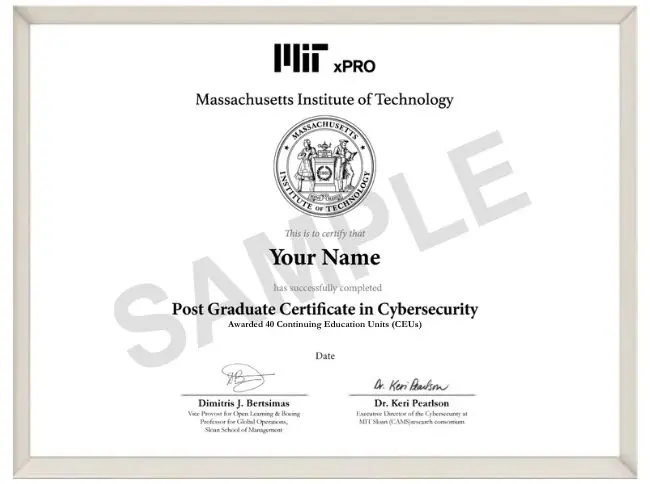
Get recognized! Upon successful completion of this program, MIT xPRO grants a certificate of completion to participants and 40 Continuing Education Units (CEUs). This program is graded as a pass or fail; participants must receive 75% to pass and obtain the certificate of completion.
After successful completion of the program, your verified digital certificate will be emailed to you, at no additional cost, with the name you used when registering for the program.
Note: All certificate images are for illustrative purposes only and may be subject to change at the discretion of MIT.
Registration for this program is done through Emeritus. You can contact us at mit.xpro@emeritus.org
This program is open for enrolments for residents of India, Bangladesh, Bhutan, Myanmar, Nepal, Pakistan, Sri Lanka, Philippines, Indonesia, Thailand, Vietnam and Malaysia only.
Note:
Learning facilitator details and office hour dates and timings are from previous batches. The learning facilitators may change for upcoming batches based on availability and the office hour timings and dates may be changed based on a mutually decided schedule between Emeritus and the Learning facilitator.
*Mentioned timelines are tentative.
The Learning Experience
What is it like to learn with the learning collaborator, Emeritus?
More than 300,000 professionals globally, across 200 countries, have chosen to advance their skills with Emeritus and its educational learning partners. In fact, 90 percent of the respondents of a recent survey across all our programs said that their learning outcomes were met or exceeded. All the contents of the course would be made available to students at the commencement of the course. However, to ensure the program delivers the desired learning outcomes, the students may appoint Emeritus to manage the delivery of the program in a cohort-based manner during the course period the cost of which is already included in the overall Course fee of the course.
A dedicated program support team is available 7 days a week to answer questions about the learning platform, technical issues, or anything else that may affect your learning experience.
FAQs
The Program
How do I know if this program is right for me?
After reviewing the information on the program landing page, we recommend you submit the short form above to gain access to the program brochure, which includes more in-depth information.
Are there any prerequisites for this program?
Some programs do have prerequisites, particularly the more technical ones. This information will be noted on the program landing page, as well as in the program brochure. If you are uncertain about program prerequisites and your capabilities, please email us at the ID mentioned above.
Note that, unless otherwise stated on the program web page, all programs are taught in English and proficiency in English is required.
What other dates will this program be offered in the future?
Check back to this program web page or email us to inquire if future program dates or the timeline for future offerings have been confirmed yet.
The Learning Experience
How much time is required each week?
Each program includes an estimated learner effort per week. This is referenced at the top of the program landing page under the Duration section, as well as in the program brochure, which you can obtain by submitting the short form at the top of this web page.
How will my time be spent?
We have designed this program to fit into your current working life as efficiently as possible. Time will be spent among a variety of activities including:
Engaging with recorded video lectures from faculty
Attending webinars and office hours, as per the specific program schedule
Reading or engaging with examples of core topics
Completing knowledge checks/quizzes and required activities
Engaging in moderated discussion groups with your peers
Completing your final project, if required
The program is designed to be highly interactive while also allowing time for self-reflection and to demonstrate an understanding of the core topics through various active learning exercises. Please email us if you need further clarification on program activities.
What is it like to learn online with the learning collaborator, Emeritus?
More than 300,000 learners across 200 countries have chosen to advance their skills with Emeritus and its educational learning partners. In fact, 90 percent of the respondents of a recent survey across all our programs said that their learning outcomes were met or exceeded.All the contents of the course would be made available to students at the commencement of the course. However, to ensure the program delivers the desired learning outcomes the students may appoint Emeritus to manage the delivery of the program in a cohort-based manner the cost of which is already included in the overall course fee of the course.A dedicated program support team is available 24/5 (Monday to Friday) to answer questions about the learning platform, technical issues, or anything else that may affect your learning experience.
How do I interact with other program participants?
Peer learning adds substantially to the overall learning experience and is an important part of the program. You can connect and communicate with other participants through our learning platform.
What is the relationship between Emeritus and MIT xPRO?
Emeritus and MIT xPRO collaborate to create and deliver educational programs. None of these programs are Title IV-eligible.
Certification
What are the requirements to earn the certificate?
Each program includes an estimated learner effort per week, so you can gauge what will be required before you enroll. This is referenced at the top of the program landing page under the Duration section, as well as in the program brochure, which you can obtain by submitting the short form at the top of this web page. All programs are designed to fit into your working life. This program is scored as a pass or no-pass; participants must complete the required activities to pass and obtain the certificate of completion. Some programs include a final project submission or other assignments to obtain passing status. This information will be noted in the program brochure. Please email us if you need further clarification on any specific program requirements.
What type of certificate will I receive?
Upon successful completion of the program, you will receive a smart digital certificate. The smart digital certificate can be shared with friends, family, schools, or potential employers. You can use it on your cover letter, resume, and/or display it on your LinkedIn profile. The digital certificate will be sent approximately two weeks after the program, once grading is complete.
Can I get the hard copy of the certificate?
No, only verified digital certificates will be issued upon successful completion. This allows you to share your credentials on social platforms such as LinkedIn, Facebook, and Twitter.
Do I receive alumni status after completing this program?
No, there is no alumni status granted for this program. In some cases, there are credits that count toward a higher level of certification. This information will be clearly noted in the program brochure.
How long will I have access to the learning materials?
You will have access to the online learning platform and all the videos and program materials for 12 months following the program start date. Access to the learning platform is restricted to registered participants per the terms of agreement.
Technical Requirements
What equipment or technical requirements are there for this program?
Participants will need the latest version of their preferred browser to access the learning platform. In addition, Microsoft Office and a PDF viewer are required to access documents, spreadsheets, presentations, PDF files, and transcripts.
Do I need to be online to access the program content?
Yes, the learning platform is accessed via the internet, and video content is not available for download. However, you can download files of video transcripts, assignment templates, readings, etc. For maximum flexibility, you can access program content from a desktop, laptop, tablet, or mobile device.Video lectures must be streamed via the internet, and any livestream webinars and office hours will require an internet connection. However, these sessions are always recorded, so you may view them later.
Payment Process
Can I still register if the registration deadline has passed?
Yes, you can register up until seven days past the published start date of the program without missing any of the core program material or learnings.
What is the program fee, and what forms of payment do you accept?
The program fee is noted at the top of this program web page and usually referenced in the program brochure as well.
Flexible payment options are available (see details below as well as at the top of this program web page next to FEE).
Tuition assistance is available for participants who qualify. Please fill up the short form.
What if I don’t have a credit card? Is there another method of payment accepted?
Yes, you can do the bank remittance in the program currency via wire transfer or debit card. Please contact your program advisor, or email us for details.
I was not able to use the discount code provided. Can you help?
Yes! Please email us with the details of the program you are interested in, and we will assist you.
How can I obtain an invoice for payment?
Please email us your invoicing requirements and the specific program you’re interested in enrolling in.
Is there an option to make flexible payments for this program?
Yes, the flexible payment option allows a participant to pay the program fee in installments. This option is made available on the payment page and should be selected before submitting the payment.
Who will be collecting the payment for the program?
Emeritus collects all program payments, provides learner enrollment and program support, and manages learning platform services.
What is the refund and cancellation policy for this program?
Refund Policy
Policy Communication:
Emeritus’ Withdrawal, Refund and Deferral policies are communicated to all learners (both existing and prospective) via the Emeritus website and Learning Management System. It is the learner’s responsibility to review, be aware of and adhere to these policies.
Withdrawal for Non-delivery of Course:
Emeritus will notify learners in writing if (a) the course will not commence on the scheduled course commencement date; (b) the course will not be completed by the scheduled course completion date; or (c) the learner does not meet the course entry or matriculation requirement as set by Emeritus or the university. Within three (3) working days of such notice, Emeritus will inform learners in writing of any available alternative study arrangements.
If a learner declines the offered alternative study arrangements, if any, or desires to otherwise withdraw from the course for the reasons stated in paragraph 2 above, the learner shall request a withdrawal from Emeritus within fifteen (15) calendar days. Upon receipt of the withdrawal request and validation of eligibility, Emeritus shall refund the learner 100% of course and miscellaneous fees previously paid by the learner, except that course application fees are non-refundable and non-transferable. Emeritus shall use commercially reasonable efforts to make such refund within seven (7) working days from receipt of the withdrawal request from learner.
Withdrawal for Other Reasons:
If the learner wishes to withdraw from the course or program for any reason other than those stated in paragraph 2 above, the following provisions shall control all withdrawal requests:
Absent a previous approved request for deferral for the course, learners may request a full refund of all course and miscellaneous fees paid, within fourteen (14) days after course commencement. Application fees for courses are non-refundable and non-transferable. Learners who have previously been granted a course deferral are not eligible for a refund for the course. Partial (or pro-rated) refunds are not offered. Emeritus shall use commercially reasonable efforts to make a valid refund within seven (7) working days from receipt of the withdrawal request from learner.
Emeritus reserves the right, in its sole discretion, to dismiss a learner from a course or program at any time and to provide a refund to the learner pursuant to the stated refund policy in paragraph 2 above. Learners who are dismissed from a course or program due to a violation of Emeritus’ Code of Conduct are not entitled to any refund.
How to Submit a Valid Withdrawal Request:
All withdrawal requests must be sent in writing within the timelines specified in paragraphs 2 or 3 above to:
All refunds will be paid directly to the original payer only, unless written and signed instruction is provided by the original payer to pay the refund to an account belonging to a person other than the original payer.
Bank Charges/Transaction Fees:
In the event of an approved refund, Emeritus will refund the course fee collected and will not be liable to refund any foreign transaction fees, processing charges, or any other bank fees.
Early Registrations Are Encouraged. Seats Fill Up Quickly!
Flexible payment options available.
Starts On