

Post Graduate Program in Data Science and AI
Harness the power of AI and data with MIT’s world-class faculty
- Learn from the #1 QS world ranked school
- Gain insights from top MIT faculty
- Earn a certificate from MIT xPRO and 36 CEUs
- Engage in weekly live sessions with industry experts for real-world application
The program learning will pause for holidays during Christmas & New Year (24 Dec 2026 – 1 Jan 2027)
Unlock Your Potential
Emeritus is collaborating with MIT xPRO to help you build future-ready skills. Enroll before Invalid liquid data and get 6% tuition assistance to set yourself up for professional success.
Predict. Plan. Perform.
To empower professionals with future-ready skills, the Post Graduate Program in Data Science and AI by MIT xPRO has been crafted by globally renowned MIT faculty and blends deep academic learning with real-world application—enabling participants to develop core competencies in AI, predictive analytics and cloud computing.
INR 49 LPA
$17 billion
Why is this program one of a kind?

Learn at your own pace with pre-recorded video lectures* by MIT faculty

Engage in weekly live sessions led by top data science and AI experts for deeper insights and real-world perspectives

Reinforce your learning with mini projects and assignments throughout the program

Access Virtual Labs with 25+ leading data science tools and libraries

Showcase your proficiency in solving real-world problems through a 2-week Capstone Project

Earn a Certificate of Completion from MIT xPRO & 36 Continuing Education Units (CEUs)
Note: *100% recorded weekly lectures by MIT faculty. Some weeks are primarily application-focused and do not have faculty recorded lectures and will only have live hands-on sessions by industry experts *

Tailored to meet your skill needs
Data Analysts and Business Analysts:
Looking to transition into data science roles or enhance their analytical skill
Tech Professionals:
Aiming to apply data science techniques to solve real-world problems
Note: Basic knowledge of math, excel dataset usage and exposure to programming concepts is required. The program is also open to learners with no prior programming experience (but additional efforts may be required).
Getting you industry ready, the MIT way.

Leverage data to optimize processes and enhance decision-making

Use Python and Google Colab to train, run, and analyze datasets and models effectively

Translate technical results into actionable business insights for executive decision-making

Build a portfolio using regression, deep learning, NLP, and more to solve real-world problems

Apply AI to extract insights and stay current with the latest in AI and ML
About MIT xPRO
MIT xPRO’s online learning programs leverage MIT's leadership in innovation, science, engineering, and technical disciplines with vetted content from world-renowned experts to make learning accessible anytime, anywhere. Designed using cutting-edge research in the neuroscience of learning, MIT xPRO programs are application-focused, helping professionals to build their skills while on the job.
#1
#2
A curriculum that goes beyond traditional learning
Pillar 1. Math and Stats Fundamentals
Build a strong foundation with core concepts in data science and analytics, including systems thinking and real-world case studies. Understand probability, distributions, and risk modeling, and explore how to identify and interpret variable relationships using correlation techniques like Pearson and Spearman.
Module 1: Introduction to data science Introduction to data science and analytics, systems approaches, case studies (hospital prediction, business optimization)
Module 2: Thinking about Risk and Uncertainty through Probability and Distributions Summary statistics, probability theory, distributions, risk modeling
Module 3: Correlation Correlation coefficients (Pearson, Spearman), identifying and interpreting variable relationships
Live Learning sessions: Data Science Foundations & Roles, Dashboards with Power BI & DAX, Python & Pandas for Data Handling, EDA & Correlation Techniques, Stats Inference & Hypothesis Testing
Pillar 2. Data Analytics & Machine Learning
Dive into core data science techniques — explore K-means, hierarchical clustering, and unsupervised segmentation to identify patterns in raw data. Learn how to apply linear and logistic regression to real-world scenarios, diagnose model fit, and interpret key metrics like odds ratios and ROC curves. You'll also get hands-on with recommendation systems using user-item matrices.
Module 4: Clustering K-means, hierarchical clustering, unsupervised segmentation
Module 5: Linear Regression Part 1 Introduction to linear regression, line fitting, assumptions
Module 6: Linear Regression Part 2 Multiple regression, multicollinearity, diagnostics
Module 7: Logistic Regression Binary classification, odds ratios, confusion matrix, ROC
Module 8: Collaborative Filtering Recommendation systems using user-item matrices
Live Learning sessions: Clustering hands-on and visualization, regression walkthrough, multivariable model building, classification metrics, ROC/AUC, tree-based models, user-item matrix, cold start and sparsity challenges
Pillar 3. Optimization & Advanced ML Applications
Apply advanced ML and optimization techniques — explore linear programming, real-world business applications, and mixed-integer and non-linear models. Learn how ad auctions and bidding strategies work, simulate large-scale supply chain optimizations, and compare regression with classification models. You’ll also work with ensemble methods like Random Forests and XGBoost, and understand fairness, bias, and ethical concerns in AI systems.
Module 9: Linear Optimization Models Linear programming, constraints, objective function
Module 10: Linear Optimization Models, Case Study Real-world application of LP in business/operations
Module 11: Integer, Nonlinear, and Discrete Optimization Models Mixed integer programming, non-linear optimization
Module 12: Sponsored, Internet Search Advertising, Case Study Ad auctions, bidding strategies, click-through modeling
Module 13: Large-Scale Optimization, UN World Food Programme Supply chain logistics, large-scale model constraints
Module 14: Regression and Classification Comparison of regression and classification, hybrid models
Module 15: Ensemble Models Random forests, boosting (Ada, XGBoost)
Module 16: Fairness and Bias Issues in Data-Driven Predictions Ethical AI, bias detection, mitigation strategies
Live Learning sessions: LP formulation and solving, Excel/Python demo, case-based applications, mixed-integer modeling, ad bidding simulation, supply chain optimization walkthrough, delivery trade-offs
Pillar 4. Deep Learning Techniques
Dive into deep learning and NLPs — understand how neural networks work, from perceptrons to CNNs and transfer learning. Explore model training, backpropagation, and tuning techniques. Learn text preprocessing, tokenization, and vectorization, then move into language modeling, sentiment analysis, and NLP classification techniques.
Module 17: Neural Networks Part 1 Perceptrons, architecture of neural networks
Module 18: Neural Networks Part 2 Backpropagation, hyperparameters, tuning
Module 19: Neural Networks Part 3 CNNs, advanced architectures, transfer learning
Module 20: Natural Language Processing (NLP) Part 1 Text processing, tokenization, vectorization
Module 21: Natural Language Processing (NLP) Part 2 Language modeling, classification, sentiment analysis
Live Learning sessions: Build neural nets in TensorFlow/Keras, tune hyperparameters, visualize learning, CNN hands-on, sequence prediction with RNNs, LSTM/GRU basics
Pillar 5. Decision Systems
Bridge insight and impact — explore model explainability with SHAP and causality theory to drive trustworthy decisions. Learn how analytics and optimization integrate into business strategy and understand what it takes to lead AI-driven transformation with effective change management and leadership frameworks.
Module 22: Interpretability and Causality in Models Model explainability, SHAP, causality theory
Module 23: Data, Models, and Decisions Integration of analytics, optimization, decision science
Module 24: Leading Digital Transformations Change management, AI strategy, transformation leadership
Live Learning sessions: Explainability walkthrough, SHAP demo, business decisions from models, transformation case studies, leadership in AI adoption, change management frameworks
Access 25+ tools and libraries























Note:
Tools & libraries are subject to change as per the discretion of MIT xPRO or Emeritus.
All products and company names are trademarks or registered trademarks of their respective holders. Use of them does not imply any affiliation with or endorsement by them.
Analyze Real-World Case Studies

Retail Management
Analyze how a Boston, MA retailer handled its response to the Covid-19 pandemic using the systems approach.

Filatoi Riuniti
Solve an optimization problem by developing a model and making recommendations on how this Italian yarn manufacturer should outsource production in order to maximize profits.

Facial Analysis Algorithms
Examine the ramifications of poorly designed models and discover how to detect, diagnose, and mitigate biases that can arise in model-based, data-driven decision making.

BlueBikes
See how BlueBikes used regression to predict demand. Then build your own models with regression and use R² to pick the optimal model.
Turn practice into perfection through projects

Prediction model with XGBoost
Construct an XGBoost model to predict diabetes in a patient, using various diagnostic variables and a diabetes dataset

Heart Rate Modeling with Neural Networks
Utilize TensorFlow and Keras to create a neural network for a novel dataset focusing on heart rate

Develop a Music Recommendation System
Develop a collaborative filtering model for a music recommendation system/data set

Image classification with Transfer Learning
Execute transfer learning on a multi-class image classification scenario

Sentiment Analysis on IMDB Reviews
Apply NLP to determine the sentiment of movie reviews from IMDB

Text Classification with Transformers
Apply NLP to utilize a transformer and increase accuracy in a prediction model
Meet the faculty

Vivek Farias
Patrick J. McGovern (1959) Professor, Professor of Operations Management, MIT Sloan School of Management
Vivek Farias currently holds the prestigious Patrick J. McGovern Professorship at MIT Sloan, where he leads research in operations management and optimization. He is also affi...

Robert Freund
Theresa Seley Professor in Management Science, Professor of Operations Research, MIT Sloan School of Management
Robert Freund is the Theresa Seley Professor at MIT Sloan and a former Deputy Dean, reflecting his longstanding leadership within the institution. He is one of the most respec...

Retsef Levi
J. Spencer Standish (1945) Professor of Management Professor of Operations Management MIT Sloan School of Management
Retsef’s research focuses on the design of analytical data-driven decision support models and tools addressing complex business and system design decisions under uncertainty i...

Rama Ramakrishnan
Professor of the Practice Artificial Intelligence/Machine Learning MIT Sloan School of Management
Rama’s research and teaching interests focus on the application of data science and machine learning techniques to problems in industry and the creation of intelligent product...
Testimonials
Certificate
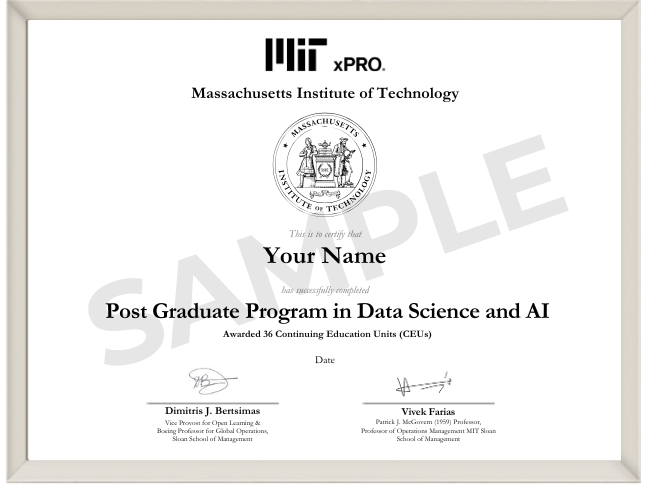
Upon successful completion of the program, MIT xPRO grants a certificate of completion to participants and 36 Continuing Education Units (CEUs). This post graduate program is graded as a pass or fail; participants must receive 75% to pass and obtain the certificate of completion. Your verified digital certificate will be emailed to you, at no additional cost, with the name you used when registering for the program.
Career Services

Resume-builder tool
6-month access to DIY resume builder
Auto resume creator with optimization suggestions
Unlimited resume iterations within the duration

Career preparation modules
Resume and cover letter essentials
Maximizing LinkedIn and job search strategy
Interview preparation and personal branding
Note: -
MIT xPRO or Emeritus do not promise or guarantee a job or progression in your current job. Career Services is only offered as a service that empowers you to manage your career proactively. The Career Services mentioned here are offered by Emeritus. MIT xPRO is NOT involved in any way and makes no commitments regarding the Career Services mentioned here.
Registration for this program is done through Emeritus. You can contact us at mit.xpro@emeritus.org
This program is open for enrolments for residents of India, Bangladesh, Bhutan, Myanmar, Nepal, Pakistan, Sri Lanka, Philippines, Indonesia, Thailand, Vietnam and Malaysia only.
FAQs
How is the program teaching split between MIT faculty and industry experts?
This program is taught by both MIT faculty and industry experts. Weekly recorded videos are by MIT Faculty, and weekly live sessions are conducted by industry experts. Some weeks do not have recorded lectures by MIT faculty and will only have live sessions by industry experts.
Who grades/reviews assignments and projects?
Assignments will be graded by industry practitioners who support participants in their learning journeys and/or by the Emeritus grading team
Will the institute/Emeritus help with placement services?
This program is designed with some of the best faculty to cover relevant topics in a manner that creates positive career outcomes. Additionally, we provide a 6-month IIMJobs Pro Membership with access to job insights, recruiter actions, profile boosts, and an AI powered resume builder. Career prep modules on resumes, LinkedIn profile optimization, job navigation and interview preparation are also provided
What type of certificate will I receive?
Upon successful completion of the program, you will receive a smart digital certificate. This can be shared with friends, family, schools, or potential employers. You can use it in your cover letter and resume and/or display it on your LinkedIn profile.
How long will I have access to the learning materials?
You will have access to the online learning platform and all the videos and program materials for 12 months following the program end date. Access to the learning platform is restricted to registered participants per the terms of the agreement.
Is there a qualifying mark/grade to get the final certification in this program?
Yes, the qualifying mark is 75% and minimum 50% attendance in live sessions are recommended
What is the refund policy for this program?
Refund Policy
Policy Communication:
Emeritus’ Withdrawal, Refund and Deferral policies are communicated to all learners (both existing and prospective) via the Emeritus website and Learning Management System. It is the learner’s responsibility to review, be aware of and adhere to these policies.
Withdrawal for Non-delivery of Course:
Emeritus will notify learners in writing if (a) the course will not commence on the scheduled course commencement date; (b) the course will not be completed by the scheduled course completion date; or (c) the learner does not meet the course entry or matriculation requirement as set by Emeritus or the university. Within three (3) working days of such notice, Emeritus will inform learners in writing of any available alternative study arrangements.
If a learner declines the offered alternative study arrangements, if any, or desires to otherwise withdraw from the course for the reasons stated in paragraph 2 above, the learner shall request a withdrawal from Emeritus within fifteen (15) calendar days. Upon receipt of the withdrawal request and validation of eligibility, Emeritus shall refund the learner 100% of course and miscellaneous fees previously paid by the learner, except that course application fees are non-refundable and non-transferable. Emeritus shall use commercially reasonable efforts to make such refund within seven (7) working days from receipt of the withdrawal request from learner.
Withdrawal for Other Reasons:
If the learner wishes to withdraw from the course or program for any reason other than those stated in paragraph 2 above, the following provisions shall control all withdrawal requests:
Absent a previous approved request for deferral for the course, learners may request a full refund of all course and miscellaneous fees paid, within fourteen (14) days after course commencement. Application fees for courses are non-refundable and non-transferable. Learners who have previously been granted a course deferral are not eligible for a refund for the course. Partial (or pro-rated) refunds are not offered. Emeritus shall use commercially reasonable efforts to make a valid refund within seven (7) working days from receipt of the withdrawal request from learner.
Emeritus reserves the right, in its sole discretion, to dismiss a learner from a course or program at any time and to provide a refund to the learner pursuant to the stated refund policy in paragraph 2 above. Learners who are dismissed from a course or program due to a violation of Emeritus’ Code of Conduct are not entitled to any refund.
How to Submit a Valid Withdrawal Request:
All withdrawal requests must be sent in writing within the timelines specified in paragraphs 2 or 3 above to:
All refunds will be paid directly to the original payer only, unless written and signed instruction is provided by the original payer to pay the refund to an account belonging to a person other than the original payer.
Bank Charges/Transaction Fees:
In the event of an approved refund, Emeritus will refund the course fee collected and will not be liable to refund any foreign transaction fees, processing charges, or any other bank fees.
Note: *100% recorded weekly lectures by MIT faculty. Some weeks are primarily application-focused and do not have faculty recorded lectures and will only have live hands-on sessions by industry experts **QS world rankings 2025, US News rankings 2025 Note: Basic knowledge of math, excel dataset usage and exposure to programming concepts is required. The program is also open to learners with no prior programming experience (but additional efforts may be required)
Early Registrations Are Encouraged. Seats Fill Up Quickly!
Flexible payment options available.
Starts On