

Rapid Prototyping Methodologies for Commercial Application
Step into the future of product development
Reimagine Product Development With Rapid Prototyping
Consider how your company brings a product to market. Then imagine if you could make the process more efficient and less expensive. Rapid prototyping allows you to do just that. By quickly transforming ideas into hyperrealistic models, you can fine-tune physical products to customer requirements and create efficiencies that yield an enduring competitive advantage.
This program provides a comprehensive introduction to the applications of rapid prototyping technology, giving you the knowledge to answer questions such as:
- How do I develop a prototype that emulates the look, feel, and function of a desired product?
- How do I identify the most efficient manufacturing process?
- How can rapid prototyping help me decrease costs, improve quality, and innovate for the future?
The Value of Rapid Prototyping
Months to Weeks
2–10X
Key Takeaways
Identify rapid prototyping fundamentals and the various techniques for developing the prototypes.
Recognize how rapid prototyping can increase agility in design and manufacturing.
Understand how to map desired product attributes to concept prototype attributes.
Analyze the benefits and drawbacks of serial and parallel fabrication processes to develop a rapid prototype.
Make and evaluate fabrication decisions to define strategies for creating and assessing the effectiveness of a prototype.
Assess data gathered from concept prototypes to make smart decisions on developing your desired product.
Identify how to assess and optimize the cost value of a rapid prototype.
Determine the future trends and technologies used to enhance rapid prototyping.
Program Highlights
Learn the applications of rapid prototyping technology by exploring the development of MIT’s Project Manus (COVID-19) face shield, designed by Professor Martin Culpepper, program leader and an expert in the field, and a team of his colleagues
Analyze, assess, and apply your learnings in a capstone project as you work on a prototype
Benefit from a live faculty session and weekly office hours with learning facilitators
Who Is This Program For?
Product managers and designers seeking to make design and fabrication decisions that will lead to more efficient product development
Business leaders and functional heads interested in using prototyping to refine product concepts and optimize resource allocation
Product engineers responsible for exploring, revising, and validating prototype concepts
Program Experience

Capstone project

Case studies

Assignments

Discussions

Interactive try-it activities

Workbook activities

Polls and quizzes
Program Curriculum
Module 1: The Rapid Prototyping Landscape
This module explores the role of rapid prototyping in product development, examining how it differs from traditional methods and its impact on cost, time, and the use of various tools and technologies. It also covers choosing between serial and parallel fabrication, determining the best prototyping approach, and evaluating when rapid prototyping is necessary. Learners reflect on key factors and reassess initial assumptions about its value.
Module 2: Concept Prototype Attribute Mapping
This module focuses on the value of developing a concept prototype (CP) and its role in effective product development. It involves identifying the benefits of a CP, comparing its characteristics with those of the desired product (DP), and assessing key metrics that influence the choice of fabrication processes. The module also emphasizes how clearly defined design and fabrication attributes enhance the quality of decision making. Learners evaluate specific sets of these attributes and create a structured plan for delivering informed design and fabrication feedback.
Module 3: Common "Go-To" Serial Fabrication Processes
This module examines the characteristics of manufacturing processes, with a focus on comparing serial fabrication methods to identify the most cost-effective and time-efficient options. It begins by clarifying the distinction between fabrication and manufacturing processes and explains their relevance to rapid prototyping. Learners assess the strengths, weaknesses, and ideal applications of common serial fabrication methods, evaluate comparison metrics, and apply these insights to informed decision making and planning in serial fabrication.
Module 4: Common "Go-To" Parallel Fabrication Processes
This module focuses on evaluating parallel fabrication processes to identify the most cost-effective and time-efficient option for a given scenario. It involves assessing the strengths, weaknesses, and ideal applications of common parallel fabrication methods, comparing these processes to determine optimal choices, and analyzing needs assessments, hypotheses, and fabrication decisions within a rapid prototyping proposal.
Module 5: Smart Design and Fabrication Decisions
This module outlines the general framework for creating a basic prototyping plan. It guides learners in developing a process plan and strategy for building a prototype, distinguishing between technical and nontechnical requirements. The module also focuses on identifying decision-making attributes that maximize the value of a concept prototype and evaluating the associated costs and quality of prototype development.
Module 6: Designing Concept Prototypes (CP) that Emulate Desired Products (DP)
This module focuses on designing concept prototypes that effectively emulate desired products. Learners develop and evaluate hypotheses for concept prototypes, emphasizing defined attributes and expected outcomes. It also involves comparing virtual and physical prototypes, analyzing their advantages and limitations, and assessing gaps in the data collected during prototype testing to ensure alignment with the original hypothesis.
Module 7: Assessing the Cost and Value of Rapid Prototyping
This module explores how rapid prototyping can be used to reduce costs and improve quality in product development. It involves analyzing the key factors and decision-making processes that help maximize value from prototypes, as well as identifying cost drivers and trade-offs that impact their effectiveness. Learners evaluate various assessments and strategies aimed at optimizing the cost-to-value ratio of rapid prototypes.
Module 8: The Future of Manufacturing.
This module examines the future of machine learning in designing and modeling rapid prototypes. It covers core principles of rapid prototyping applicable across industries, explores opportunities for leading and assessing team efforts using rapid prototyping, and analyzes the unique context of an organization for applying these methods. Learners are also guided in identifying the next steps for expanding their rapid prototyping skills.
Faculty

MARTIN CULPEPPER
Professor of Mechanical Engineering at MIT
Professor Culpepper’s research concentrates on the invention, design, and fabrication of high-performance machine systems. He focuses on inventing new technologies in areas wh...
Guest Speakers

FAEZ AHMAD
Assistant Professor, MIT

ELAZER EDELMAN
Director, Institute for Medical Engineering and Science, MIT, Edward J. Poitras Professor in Medical Engineering and Science, Massachusetts Institute of Technology, Professor ...

AMOS WINTER
Ratan N. Tata Career Development Professor; Associate Professor

JOHN HART
Professor of Mechanical Engineering; Director, Laboratory for Manufacturing and Productivity (LMP); MechE Maker Czar
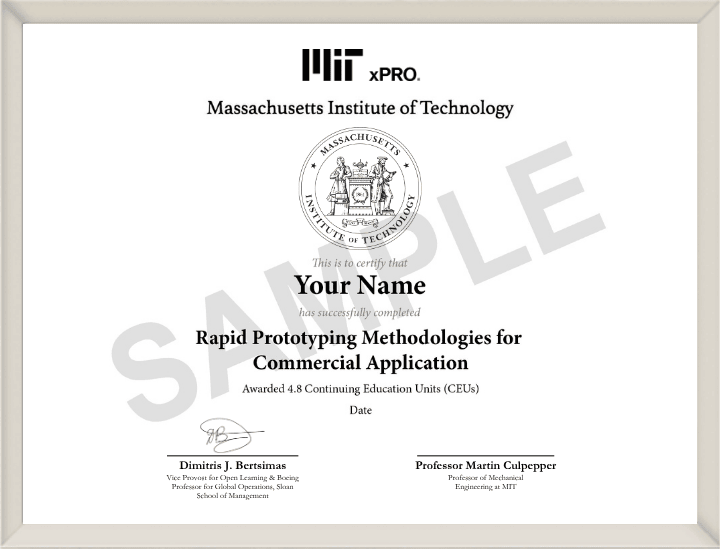
Certificate
Get recognized! Upon successful completion of this program, you receive 4.8 Continuing Education Units (CEUs), a globally recognized measure of professional learning that reflects compliance with international quality standards, and a certificate of completion from MIT xPRO.
This program is graded as a pass or fail; participants must receive 75 percent to pass and obtain the certificate of completion.
Note: After successful completion of the program, your verified digital certificate will be emailed to you, at no additional cost, with the name you used when registering for the program. All certificate images are for illustrative purposes only and may be subject to change at the discretion of MIT.
FAQs
The Program
How do I know if this program is right for me?
After reviewing the information on the program landing page, we recommend you submit the short form above to gain access to the program brochure, which includes more in-depth information. If you still have questions on whether this program is a good fit for you, please email learner.success@emeritus.org, and a dedicated program advisor will follow-up with you very shortly.
Are there any prerequisites for this program?
Some programs do have prerequisites, particularly the more technical ones. This information will be noted on the program landing page, as well as in the program brochure. If you are uncertain about program prerequisites and your capabilities, please email us at the ID mentioned above.
Note that, unless otherwise stated on the program web page, all programs are taught in English and proficiency in English is required.
What is the typical class profile?
More than 50 percent of our participants are from outside the United States. Class profiles vary from one cohort to the next, but, generally, our online certificates draw a highly diverse audience in terms of professional experience, industry, and geography — leading to a very rich peer learning and networking experience.
What other dates will this program be offered in the future?
Check back to this program web page or email us to inquire if future program dates or the timeline for future offerings have been confirmed yet.
The Learning Experience
How much time is required each week?
Each program includes an estimated learner effort per week. This is referenced at the top of the program landing page under the Duration section, as well as in the program brochure, which you can obtain by submitting the short form at the top of this web page.
How will my time be spent?
We have designed this program to fit into your current working life as efficiently as possible. Time will be spent among a variety of activities including:
Engaging with recorded video lectures from faculty
Attending webinars and office hours, as per the specific program schedule
Reading or engaging with examples of core topics
Completing knowledge checks/quizzes and required activities
Engaging in moderated discussion groups with your peers
Completing your final project, if required
The program is designed to be highly interactive while also allowing time for self-reflection and to demonstrate an understanding of the core topics through various active learning exercises. Please email us if you need further clarification on program activities.
What is it like to learn online with the learning collaborator, Emeritus?
More than 300,000 learners across 200 countries have chosen to advance their skills with Emeritus and its educational learning partners. In fact, 90 percent of the respondents of a recent survey across all our programs said that their learning outcomes were met or exceeded.
All the contents of the course would be made available to students at the commencement of the course. However, to ensure the program delivers the desired learning outcomes the students may appoint Emeritus to manage the delivery of the program in a cohort-based manner the cost of which is already included in the overall course fee of the course.
A dedicated program support team is available 24/5 (Monday to Friday) to answer questions about the learning platform, technical issues, or anything else that may affect your learning experience.
How do I interact with other program participants?
Peer learning adds substantially to the overall learning experience and is an important part of the program. You can connect and communicate with other participants through our learning platform.
What is the relationship between Emeritus and MIT xPRO?
Emeritus and MIT xPRO collaborate to create and deliver educational programs. None of these programs are Title IV-eligible.
Certification
What are the requirements to earn the certificate?
Each program includes an estimated learner effort per week, so you can gauge what will be required before you enroll. This is referenced at the top of the program landing page under the Duration section, as well as in the program brochure, which you can obtain by submitting the short form at the top of this web page. All programs are designed to fit into your working life.
This program is scored as a pass or no-pass; participants must complete the required activities to pass and obtain the certificate of completion. Some programs include a final project submission or other assignments to obtain passing status. This information will be noted in the program brochure. Please email us if you need further clarification on any specific program requirements.
What type of certificate will I receive?
Upon successful completion of the program, you will receive a smart digital certificate. The smart digital certificate can be shared with friends, family, schools, or potential employers. You can use it on your cover letter, resume, and/or display it on your LinkedIn profile.The digital certificate will be sent approximately two weeks after the program, once grading is complete.
Can I get the hard copy of the certificate?
No, only verified digital certificates will be issued upon successful completion. This allows you to share your credentials on social platforms such as LinkedIn, Facebook, and Twitter.
Do I receive alumni status after completing this program?
No, there is no alumni status granted for this program. In some cases, there are credits that count toward a higher level of certification. This information will be clearly noted in the program brochure.
How long will I have access to the learning materials?
You will have access to the online learning platform and all the videos and program materials for 24 months following the program start date. Access to the learning platform is restricted to registered participants per the terms of agreement.
Technical Requirements
What equipment or technical requirements are there for this program?
Participants will need the latest version of their preferred browser to access the learning platform. In addition, Microsoft Office and a PDF viewer are required to access documents, spreadsheets, presentations, PDF files, and transcripts.
Do I need to be online to access the program content?
Yes, the learning platform is accessed via the internet, and video content is not available for download. However, you can download files of video transcripts, assignment templates, readings, etc. For maximum flexibility, you can access program content from a desktop, laptop, tablet, or mobile device.
Video lectures must be streamed via the internet, and any livestream webinars and office hours will require an internet connection. However, these sessions are always recorded, so you may view them later.
Payment Process
Can I still register if the registration deadline has passed?
Yes, you can register up until seven days past the published start date of the program without missing any of the core program material or learnings.
What is the program fee, and what forms of payment do you accept?
The program fee is noted at the top of this program web page and usually referenced in the program brochure as well.
Flexible payment options are available (see details below as well as at the top of this program web page next to FEE).
Tuition assistance is available for participants who qualify. Please email learner.success@emeritus.org.
What if I don’t have a credit card? Is there another method of payment accepted?
Yes, you can do the bank remittance in the program currency via wire transfer or debit card. Please contact your program advisor, or email us for details.
I was not able to use the discount code provided. Can you help?
Yes! Please email us with the details of the program you are interested in, and we will assist you.
How can I obtain an invoice for payment?
Please email us your invoicing requirements and the specific program you’re interested in enrolling in.
Is there an option to make flexible payments for this program?
Yes, the flexible payment option allows a participant to pay the program fee in installments. This option is made available on the payment page and should be selected before submitting the payment.
How can I obtain a W9 form?
Please connect with us via email for assistance.
Who will be collecting the payment for the program?
Emeritus collects all program payments, provides learner enrollment and program support, and manages learning platform services.
Are there any restrictions on the types of funding that can be used to pay for the program?
Program fees for Emeritus programs with MIT xPRO may not be paid for with (a) funds from the GI Bill, the Post-9/11 Educational Assistance Act of 2008, or similar types of military education funding benefits or (b) Title IV financial aid funds.
Refund Policy
What is the program refund and deferral policy?
For the program refund and deferral policy, please click the link here.
Accessibility
How does Emeritus support accessibility for learners?
Emeritus is committed to making high-quality education accessible and affordable to individuals, companies, and governments around the world. If you have questions about accessibility or would like to discuss available support options before enrolling, please contact accessibility@emeritus.org. For more information about our accessibility practices, please review our Accessibility Policy here.
Didn't find what you were looking for? Write to us at learner.success@emeritus.org or Schedule a call with one of our Program Advisors or call us at +1 401 443 9591 (US) / + 44 189 236 2347 (UK) / +65 3129 7174 (SG)
Flexible payment options available.
Starts On