

Technology and Innovation Acceleration Program
Manage people and technology with excellence
Pay Nothing While You Learn. Financing Options Starting At US$25/Month. Learn more
Leading Into the Next Frontier
Just as technology and business have joined forces to co-create value, technology and leadership have conspired to require a new kind of leader. The skills required of leaders to achieve breakout performance have shifted—dramatically. Now is the time to step out of your comfort zone and prepare for the next frontier.
In order to support technology professionals on this journey, more than 15 MIT faculty have distilled their expertise on key technology accelerators, along with principles of organizational strategy and leadership, into the six-month Technology and Innovation Acceleration Program online.
Being a future-ready leader is about managing both technology and people with excellence. That’s the MIT way.
Organizing Principle: The Six Pillars of Technology Management
Pillar 1: Critical thinking
Analyze the evidence, consider alternate solutions, solve complex problems
Pillar 2: System thinking
Understand how the components of a system interact with each other, identify interdependencies, solve more problems
Pillar 3: Creating value through emerging technologies
Evaluate what technologies can solve your problems and pay off
Pillar 4: Radical innovation
Establish the ground rules for exponential growth
Pillar 5: Organizational strategy
Identify how technology impacts your organizational structure and strategy
Pillar 6: Leadership
Mobilize the people and resources needed to achieve breakthrough performance
Who Is This Program For?
Every industry is prone to disruption. This program is ideal for individuals who are seeking to be on the leading edge of technology innovation while also applying organizational strategies to bolster success. Representative roles include:
Mid- to senior-level managers preparing for technology leadership roles
Functional department heads and business leaders looking to drive tech innovation and strategy across their organization
Senior technology leaders seeking to lead technology innovation, build high-performing teams, and develop strategies for achieving organizational alignment
Consultants seeking to explore emerging technologies, such as AI and AR/VR tools for enabling innovation, and business applications in order to offer cutting-edge solutions for clients
Key Takeaways
Implementing system thinking and architecture to analyze complex systems or processes, create new models, and utilize strategic decision-making
Exploring emerging technologies and their business applications, including artificial intelligence, augmented reality, virtual reality, and quantum computing
Identifying core features and strategies to execute various forms of radical innovation
Aligning organizational strategy to products and teams
Creating and reinforcing a culture of innovation within the organization through advanced leadership strategies
Program Modules
Over the course of six months, you will examine the range of capabilities, from critical thinking to emerging technology to managing technology and innovation, to help you lead with excellence.
Get introduced to the concept of critical thinking and meta-cognition, the processes used to plan, monitor, and assess one's own understanding. Learn to implement critical thinking for solving complex problems by analyzing alternative solutions critically and identifying types of evidence for or against the alternative solutions.
Receive an introduction to the concept of information literacy and various research techniques to help you form conclusions. Assess the strength of evidence and relate evidence to different social and technical factors.
Practice group decision-making processes that focus on convergence and gathering information by using the Pugh Matrix and the Evaluation Matrix. Learn how MIT’s D-Lab applies these matrices into their research to develop and advance practical solutions to global poverty challenges.
Understand the elements of system thinking through a diverse set of self-assessment activities and learning scenarios. Apply these concepts to a personal activity system and a professional activity system of your choice.
Learn how system thinking is applied to a diverse array of applications, including logistics, transportation systems, and computational systems.
Describe the architecture of a system and identify both architectural decisions and non-architectural decisions. Identify the various elements in architecture representations and place these in the context of the overall documentation of the system.
Learn to construct a DSM, either by analyzing the design or by converting a graph of the system. Construct a process architecture DSM and identify how it is different from a design DSM.
Understand the process of tradespace exploration by defining value, a key metric by which designs are compared. Develop a model of value by characterizing a design using attributes and organize these attributes into hierarchies for evaluation and summation.
Get acquainted with the stages involved in the design process for AI-based products and services with a focus on cost metrics and technical requirements of an AI software development plan.
Identify various machine learning algorithms and study the different approaches, such as Bayesian and regression models. Learn about unsupervised and semi-supervised methods of machine learning algorithms. Run and analyze the results from various machine learning algorithms.
Building on the knowledge of machine learning fundamentals gained in module 10, explore the basics of deep learning. Topics include neural networks, artificial neurons, and simulation of complex networks.
Identify superhuman intelligence used in an AI product. Compare and contrast the advantages and disadvantages of using an AI technology.
Discover immersive media, including augmented reality, and virtual reality. Learn to differentiate the unique elements of AR, VR, and mixed reality and learn about the software and hardware requirements of each.
Understand the applications of AR/VR in diverse fields such as medicine, military, and education. Learn about AI-enhanced augmented reality and drive innovation using AR/VR powered solutions. Analyze the impact of 5G on AR/VR experience and the long-term impact of COVID-19 on remote and virtual experiences.
Learn about the core concept of quantum computing, its origin, and how it is different from other forms of computing. Compare and contrast classical computers (desktops, laptops, tablets, cloud servers, etc.) with quantum computers. Learn about the timeline for quantum computing and explore the types of problems that are a challenge for classical computers, but can be efficiently solved on a quantum computer.
Get an introduction to radical innovation, a concept that is diametrically opposed to incremental innovation. Learn the core features of technical innovation in the modern world and the philosophy and strategies needed in an organization to execute various forms of innovation.
Understand the factors that pose a threat to innovation, both internal and external. Explore concepts such as super technologies, business model innovation, and developing your innovation pipeline.
Understand the most important elements of how to innovate. Explore different methodologies such as Lean and Agile for executing innovation, and learn about testing, rapid prototyping, and design to lead innovation within your organization.
Recognize the key elements of strategy, the precursors to strategy, and the influence of strategy on products. Analyze the impact of technological changes on organizational strategy and apply strategic thinking for gaining competitive advantage.
Learn how to create, staff, and mobilize the people and resources needed to effectively launch new project teams and improve existing ones. Examine strategies for managing three main types of group conflict: task-related conflict, relational conflict, and process conflict.
Explore different strategies to increase effectiveness and to build teams in a productive way. Learn to architect an effective organization that supports teams and teams' success. Implement post-mortems to capture lessons learned and build future capability in teamwork.
Get introduced to organizational networks and learn about the different categories of networks like social network, closed network, and open network. Identify the key players, their roles, and importance while leading change within an organization.
Program Highlights

Engage with peers to exchange perspectives, analyze governance challenges, and deepen your understanding through collaborative dialogue.

Individualized feedback on assignments

Weekly live office hours with Q&A (learning facilitator led)

Access to cutting-edge technologies and concepts from MIT

Application of learning through a final capstone project

Earn a certificate and 14.4 Continuing Education Units (CEUs) from MIT xPRO
Capstone Project
The capstone project uses the six pillars as the cornerstone of an authentic technology management project aligned to your current or aspirational technology leader role. The final capstone applies learning from each pillar to solve a challenge with practical applications. You will be able to design a project that can be integrated into your real-world setting.
Case Studies

JumpToPC
For many in developing countries, personal computers are out of reach. MIT D-Lab is collaborating with partners to develop a platform that uses a household’s existing smartphone or television to offer at-home computing solutions. Examine the strategic decisions made along the development journey.

Toyota
Were sticky pedals and floor mats to blame for the "unintended acceleration" issues on many Toyota vehicles, or was it a problem with the sensors or software? Peer into the investigation and explore how critical thinking and decision-making were used and abused.

The Robot Compiler
Take a system-thinking tour of how making a custom robot is made possible by compiling parts from a database. Examine each of the computation-driven steps in the process of fabricating a robot—so easy, anyone can have a personal robot.

The Apollo Mission
With countless decisions to be made and competing priorities, how does a team organize a mission to the moon? Examine the decision-making process that the Apollo team used, distinguishing between the architectural decisions that needed to be made first and those decisions that could be made downstream.
MIT Instructors

Seley Distinguished Professor of Management, Professor of Organization Studies, and Founder of the MIT Leadership Center at the MIT Sloan School of Management
Ancona's pioneering research into how successful teams operate has highlighted the critical importance of managing outside, as well as inside, the team's boundary. Ancona's wo...

Professor and Associate Department Head of Aeronautics and Astronautics at the Massachusetts Institute of Technology
Balakrishnan's current research interests are in the design, analysis, and implementation of control and optimization algorithms for large-scale cyber-physical infrastructures...

Clarence J. LeBel Professor in Electrical Engineering and Computer Science at the Massachusetts Institute of Technology
Boning's research is focused on the modeling and control of variation in manufacturing, including IC, photonics, and MEMS processes, devices, and circuits. His research intere...

Director of the System Architecture Lab at the Massachusetts Institute of Technology
Cameron's research interests include technology strategy, system architecture, and the management of product platforms. He has supervised over 50 graduate students and has dir...

Professor of Aeronautics and Astronautics and Ford Professor of Engineering at the Massachusetts Institute of Technology
Crawley's research focuses on the design of complex systems, and he is the author of this text: System Architecture. He is a fellow of the AIAA, and a member of the NAE, as we...

Professor of Aeronautics and Astronautics and Engineering Systems at the Massachusetts Institute of Technology
De Weck's research focuses on how complex man-made systems such as aircraft, spacecraft, automobiles, printers, and critical infrastructures are designed and how they evolve o...

General Motors LGO Professor of Management; Professor of Management Science and Innovation; Co-Director, SDM and IDM Programs at the Massachusetts Institute of Technology
Dr. Eppinger is one of the most highly recognized scholars in the area of product development and technical project management. His research is applied to improving complex de...

MIT D-Lab Faculty Director for Research, Professor of Mechanical Engineering at the Massachusetts Institute of Technology
Frey is actively involved in design of engineering devices for the developing world, and has worked intensively with colleagues, administrators, and the Singapore Ministry of ...

Professor of Digital Media & Artificial Intelligence and Director of the MIT Center for Advanced Virtuality
Harrell's research explores the relationship between imagination and computation, and it involves developing new forms of virtual reality, computational narrative, video gamin...

Managing Director of MIT Machine Intelligence for Manufacturing and Operations
Lawler is a technology entrepreneur and executive leader with consecutive public and private exits, and early-stage investing success with leading venture firms including Acce...

Senior Lecturer, Gordon Engineering Leadership Program at the Massachusetts Institute of Technology
Niño heads leadership education for graduate students across the institute. He is strongly committed to the development of leadership among engineers and other professionals i...

Professor of the Practice of Physics, Associate Director of the Research Laboratory of Electronics (RLE), and Laboratory Fellow at MIT Lincoln Laboratory
In these roles, Oliver provides programmatic and technical leadership targeting the development of quantum and classical high-performance computing technologies. His research ...

Alfred P. Sloan Professor of Management, Professor of Work and Organization Studies, and Associate Dean for Diversity, Equity, and Inclusion at MIT Sloan School of Management
Reagans studies the origin and influence of social capital on knowledge transfer, learning rates, and overall team performance. More specifically, he examines how demographic ...

Research Scientist, Systems Engineering Advancement Research Initiative, Engineering Systems Division at the Massachusetts Institute of Technology
Ross has research interests and advises students in ongoing research projects in advanced systems design and selection methods, tradespace exploration, managing unarticulated ...

Professor of Electrical Engineering and Computer Science, and Director of CSAIL at the Massachusetts Institute of Technology
Rus' work is focused on developing the science and engineering of autonomy, toward the long-term objective of enabling a future with machines pervasively integrated into the f...

Director of Auto-ID Laboratory at the Massachusetts Institute of Technology and Accenture Convergence Initiative for Industry and Technology
Subirana's research centers on IoT and AI, and focuses on manufacturing, e-learning, the creative industries, and digital health. He is developing a voice name system that can...

Vice President for Open Learning and Professor of Mechanical Engineering at the Massachusetts Institute of Technology
Sarma is co-founder of the Auto-ID Center at MIT and developed many of the key technologies behind the EPC suite of RFID standards now used worldwide. He was the founder and C...
Pay Nothing While You Learn. Financing Options Starting At US$25/Month
We offer several options to help you afford tuition for the Technology and Innovation Acceleration Program.
Referrals – You and a colleague can each receive $950 off your tuition when you enroll together. Refer now
Group enrollments – A discount of up to 20% is available for group enrollments. For more information, email group-enrollments@emeritus.org
US Residents (Deferred payment option available)
Sallie Mae – Monthly payments starting at US$25. Click here to apply
*At the time of loan application, please select ‘Undergraduate students’ when prompted.
Rest of the World
Flexible Payment Options – Monthly payments as low as US$1,355. Click here to learn more
What is Sallie Mae?
Sallie Mae is one of the largest private student loan lenders in the industry.
What is the process to apply for a loan?
Once you’ve applied for your program, you can then apply for a loan with Sallie Mae. When approved, you’ll choose your interest rate and your repayment option and sign the loan documents. The lender will send the tuition directly to your school.
How long will it take until I get a decision?
You can receive a credit result is as few as 15 minutes.
Do I need a cosigner?
If you don’t have a credit history, you will need a cosigner for your loan. A cosigner can be a parent, relative, or any other creditworthy individual. Their good credit history may help you get a loan.
When does loan payback begin?
You can make your first payment about one month after your program starts (fixed repayment or interest repayment) or six months after your program ends (deferred repayment).
How long will I be making payments?
Most loans have a 10-year standard repayment. When you apply for the loan, you will be given more information on the repayment plan.
How do I find out how much my monthly payment is?
You can find your monthly payment on the Monthly Payment Calculator here.
Are there any circumstances that would allow me to put my loan payments on hold?
Delinquency occurs when you fail to pay all or part of your monthly student loan payment. You could be eligible for a student loan deferment, which would allow you to temporarily reduce or postpone payments on your student loans in special circumstances.
Can I pay off my loan early?
There is no penalty for paying your loan off early or paying extra throughout the life of your loan. You have the flexibility to make early payments of fully pay off your loan without prepayment fees.
What is Climb Credit?
Climb Credit is a new kind of student lender.
Climb believes education is an investment and should be treated that way — we partner with schools offering career-focused education, and then provide accessible and affordable loans to attend these schools.
What is the process to apply for a loan?
Simply type your school's name into the search bar after clicking "Apply now" to find a link to the application page. From there, you'll be able to complete our short online application.
You may also have received a link to apply for a Climb loan from your school’s admissions team, or you can find the link on your school’s website or Climb's website. Apply using your laptop, tablet, or phone.
You'll want to make sure you fill out an application for the specific school and program you'll be attending. We link our loans to each course, so your school will know you've been approved for a loan with us and that we'll be sending your tuition to them.
How long will it take until I get a decision?
On average, 4:01 minutes — and just applying will not impact your credit score. We know that your time is valuable, so we’ve kept our application as short as possible.
Do I need a cosigner?
No. Climb only fund loans for students who are attending the program. The program attendee should always be the primary borrower on the application.
During your application, you will have the option to add a co-borrower. If you have a co-borrower with a better credit score that you, adding them to your loan application can potentially help you get approved and/or receive a lower interest rate offer.
If my application is accepted, am I committed to using the financing?
No. Applying for Climb financing is free and comes and carries no commitment until you accept and finalize the loan. The initial application will not affect your credit score, and you are free to decline your loan offer if you change your mind about financing.
What are the terms of the loan?
To view the equation used to calculate your interest and monthly payments, check out this article HERE!
When does loan payback begin?
Depending on your program, we may offer loans with either an initial interest-only period while in class and for a few months after, a full deferral period while in class and for a few months after, or immediate full repayment.
For loans with an interest-only period or immediate full repayment, your first payment is due one month after your loan is funded.
How long will I be making payments?
Climb's standard loan tenor is 36 months, but you can pay any time before that, as there is no pre-payment penalty. You can repay your 3-year loan in 3 years or in 1 day.
Climb's goal is to make sure that your monthly payments stay low and affordable, which is why we give you the option to choose your term length when you apply.
Master’s students can choose between a 2-year or a 3-year repayment term.
Doctoral students can choose between a 4-year or a 5-year repayment term.
How do I find out how much my monthly payment is?
This amount is mentioned in your loan agreement.
Are there any circumstances that would allow me to put my loan payments on hold?
In order not to fall behind on your Climb loan payments, you can request a deferral of payments on your loan. A deferment will allow you to temporarily reduce your monthly loan payment amount.
Can I pay off my loan early?
Absolutely! You can pre-pay your loan, in whole or in part, at any time with no penalties.
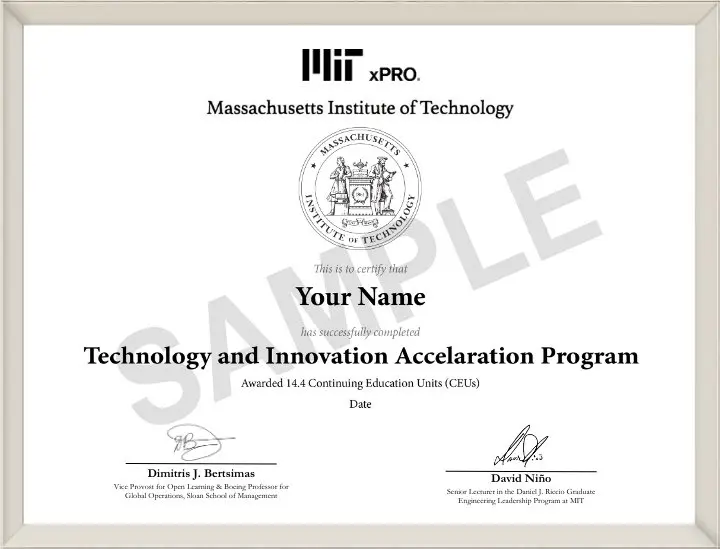
Program Certificate
Get recognized! Upon successful completion of this program, you receive 14.4 Continuing Education Units (CEUs), a globally recognized measure of professional learning that reflects compliance with international quality standards, and a certificate of completion from MIT xPRO.
This program is graded as a pass or fail; participants must receive 75 percent to pass and obtain the certificate of completion.
After successful completion of the program, your verified digital certificate will be emailed to you, at no additional cost, in the name you used when registering for the program. All certificate images are for illustrative purposes only and may be subject to change at the discretion of MIT.
FAQs
How do I know if this program is right for me?
After reviewing the information on the program landing page, we recommend you submit the short form above to gain access to the program brochure, which includes more in-depth information. If you still have questions on whether this program is a good fit for you, please email learner.success@emeritus.org, and a dedicated program advisor will follow-up with you very shortly.
Are there any prerequisites for this program?
Some programs do have prerequisites, particularly the more technical ones. This information will be noted on the program landing page, as well as in the program brochure. If you are uncertain about program prerequisites and your capabilities, please email us at the ID mentioned above.
Note that, unless otherwise stated on the program web page, all programs are taught in English and proficiency in English is required.
What is the typical class profile?
More than 50 percent of our participants are from outside the United States. Class profiles vary from one cohort to the next, but, generally, our online certificates draw a highly diverse audience in terms of professional experience, industry, and geography — leading to a very rich peer learning and networking experience.
What other dates will this program be offered in the future?
Check back to this program web page or email us to inquire if future program dates or the timeline for future offerings have been confirmed yet.
How much time is required each week?
Each program includes an estimated learner effort per week. This is referenced at the top of the program landing page under the Duration section, as well as in the program brochure, which you can obtain by submitting the short form at the top of this web page.
How will my time be spent?
We have designed this program to fit into your current working life as efficiently as possible. Time will be spent among a variety of activities including:
Engaging with recorded video lectures from faculty
Attending webinars and office hours, as per the specific program schedule
Reading or engaging with examples of core topics
Completing knowledge checks/quizzes and required activities
Engaging in moderated discussion groups with your peers
Completing your final project, if required
The program is designed to be highly interactive while also allowing time for self-reflection and to demonstrate an understanding of the core topics through various active learning exercises. Please email us if you need further clarification on program activities.
What is it like to learn online with the learning collaborator, Emeritus?
More than 300,000 learners across 200 countries have chosen to advance their skills with Emeritus and its educational learning partners. In fact, 90 percent of the respondents of a recent survey across all our programs said that their learning outcomes were met or exceeded.
All the contents of the course would be made available to students at the commencement of the course. However, to ensure the program delivers the desired learning outcomes the students may appoint Emeritus to manage the delivery of the program in a cohort-based manner the cost of which is already included in the overall course fee of the course.
A dedicated program support team is available 24/5 (Monday to Friday) to answer questions about the learning platform, technical issues, or anything else that may affect your learning experience.
How do I interact with other program participants?
Peer learning adds substantially to the overall learning experience and is an important part of the program. You can connect and communicate with other participants through our learning platform.
What is the relationship between Emeritus and MIT xPRO?
Emeritus and MIT xPRO collaborate to create and deliver educational programs. None of these programs are Title IV-eligible.
What are the requirements to earn the certificate?
Each program includes an estimated learner effort per week, so you can gauge what will be required before you enroll. This is referenced at the top of the program landing page under the Duration section, as well as in the program brochure, which you can obtain by submitting the short form at the top of this web page. All programs are designed to fit into your working life.
This program is scored as a pass or no-pass; participants must complete the required activities to pass and obtain the certificate of completion. Some programs include a final project submission or other assignments to obtain passing status. This information will be noted in the program brochure. Please email us if you need further clarification on any specific program requirements.
What type of certificate will I receive?
Upon successful completion of the program, you will receive a smart digital certificate. The smart digital certificate can be shared with friends, family, schools, or potential employers. You can use it on your cover letter, resume, and/or display it on your LinkedIn profile.The digital certificate will be sent approximately two weeks after the program, once grading is complete.
Can I get the hard copy of the certificate?
No, only verified digital certificates will be issued upon successful completion. This allows you to share your credentials on social platforms such as LinkedIn, Facebook, and Twitter.
Do I receive alumni status after completing this program?
No, there is no alumni status granted for this program. In some cases, there are credits that count toward a higher level of certification. This information will be clearly noted in the program brochure.
How long will I have access to the learning materials?
You will have access to the online learning platform and all the videos and program materials for 24 months following the program start date. Access to the learning platform is restricted to registered participants per the terms of agreement.
What equipment or technical requirements are there for this program?
Participants will need the latest version of their preferred browser to access the learning platform. In addition, Microsoft Office and a PDF viewer are required to access documents, spreadsheets, presentations, PDF files, and transcripts.
Do I need to be online to access the program content?
Yes, the learning platform is accessed via the internet, and video content is not available for download. However, you can download files of video transcripts, assignment templates, readings, etc. For maximum flexibility, you can access program content from a desktop, laptop, tablet, or mobile device.
Video lectures must be streamed via the internet, and any livestream webinars and office hours will require an internet connection. However, these sessions are always recorded, so you may view them later.
Can I still register if the registration deadline has passed?
Yes, you can register up until seven days past the published start date of the program without missing any of the core program material or learnings.
What is the program fee, and what forms of payment do you accept?
The program fee is noted at the top of this program web page and usually referenced in the program brochure as well.
Flexible payment options are available (see details below as well as at the top of this program web page next to FEE).
Tuition assistance is available for participants who qualify. Please email learner.success@emeritus.org.
What if I don’t have a credit card? Is there another method of payment accepted?
Yes, you can do the bank remittance in the program currency via wire transfer or debit card. Please contact your program advisor, or email us for details.
I was not able to use the discount code provided. Can you help?
Yes! Please email us with the details of the program you are interested in, and we will assist you.
How can I obtain an invoice for payment?
Please email us your invoicing requirements and the specific program you’re interested in enrolling in.
Is there an option to make flexible payments for this program?
Yes, the flexible payment option allows a participant to pay the program fee in installments. This option is made available on the payment page and should be selected before submitting the payment.
How can I obtain a W9 form?
Please connect with us via email for assistance.
Who will be collecting the payment for the program?
Emeritus collects all program payments, provides learner enrollment and program support, and manages learning platform services.
Are there any restrictions on the types of funding that can be used to pay for the program?
Program fees for Emeritus programs with MIT xPRO may not be paid for with (a) funds from the GI Bill, the Post-9/11 Educational Assistance Act of 2008, or similar types of military education funding benefits or (b) Title IV financial aid funds.
What is the program refund and deferral policy?
For the program refund and deferral policy, please click the link here.
Didn't find what you were looking for? Write to us at learner.success@emeritus.org or Schedule a call with one of our Academic Advisors or call us at +1 401 443 9591 (US) / + 44 189 236 2347 (UK) / +65 3129 7174 (SG)
Flexible payment options available.
Starts On